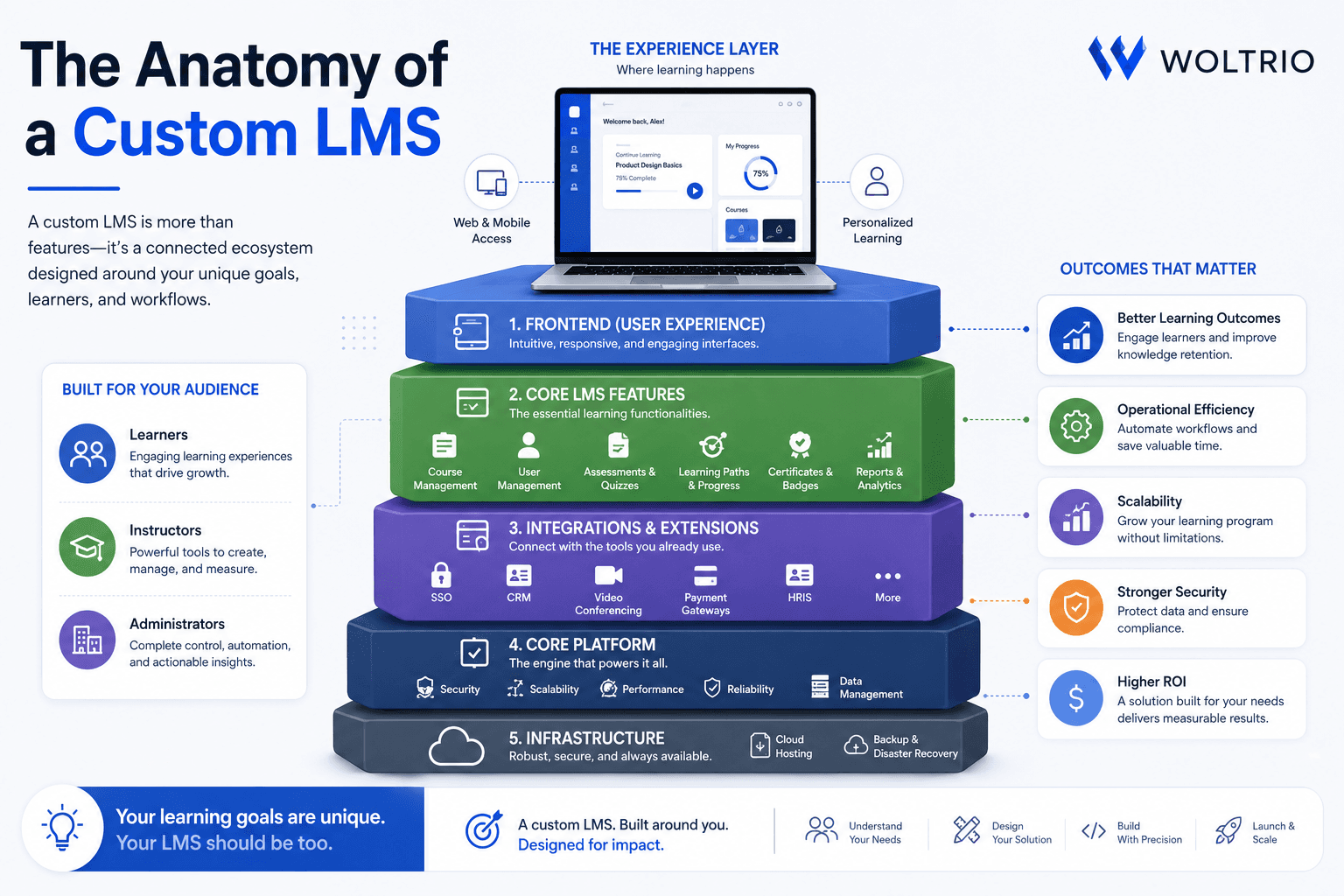
Most conversations about custom LMS development jump straight to features, course builder, quizzes, certificates, without looking at what's actually underneath those features. This breaks a learning management system down into its real layers, the ones that determine whether the finished system holds up once real staff and real data hit it.
Layer 1: Identity and Access
Everything else sits on top of this layer, and it's the one most often underbuilt. This layer decides who can log in, how, and what they can see once they're in. For most healthcare and enterprise organizations, that means single sign-on through an existing identity provider rather than a separate LMS-only login, and role-based access so a new hire, a department manager, and a compliance officer each see a different view of the same system.
Get this layer wrong and every other layer inherits the problem: duplicate accounts, stale permissions, staff locked out of training they're supposed to complete.
Layer 2: The Data Layer
Underneath the visible parts of an LMS is where staff records, course assignments, completion history, and certification data actually live. This layer needs to sync cleanly with HR systems, since an LMS with its own disconnected copy of staff data drifts out of accuracy within months as people change roles, leave, or get hired.
This is also where audit-readiness actually gets built. A compliance report is only as good as the data layer underneath it. If completion records and certification expirations aren't captured cleanly here, no amount of reporting-dashboard polish fixes that upstream.
Layer 3: Workflow and Assignment Logic
This is the layer that decides what training gets assigned to whom, and when, based on role, department, hire date, or certification expiration, without someone manually assigning it every time. Custom LMS solutions earn their name here more than anywhere else, since this logic is usually the part that's genuinely specific to how an organization actually operates, versus generic course delivery mechanics that don't need to be reinvented.
Woltrio treats this layer as the core of most custom LMS development engagements, building assignment logic around actual organizational structure rather than a generic rules engine bolted onto a course catalog.
Layer 4: Content and Course Delivery
This is the layer most people picture when they think "LMS," video playback, quizzes, course modules, certificates on completion. It's genuinely important, but it's also the layer most similar across different systems, and usually doesn't need heavy custom engineering. Where customization matters here is in how content maps to the workflow layer above it, not in reinventing video playback or quiz mechanics from scratch.
Layer 5: Reporting and Compliance Output
This layer turns everything happening in the layers below into something a compliance officer or department head can actually use, completion rates by department, certification expirations coming up in the next thirty days, an audit-ready export when a regulator asks for one. A learning management system development project that treats this layer as an afterthought usually produces a system where getting a real report still means exporting data and rebuilding it manually, which defeats a lot of the purpose of building custom in the first place.
Layer 6: The Interface
This is the layer every stakeholder judges the system by first, and the layer that determines whether staff actually complete training or quietly avoid the system. It sits on top of everything else, but it's not cosmetic, a confusing interface on top of a well-built data and workflow layer still produces low completion rates. Woltrio's UI/UX design work treats this layer as functionally important, not decorative, since it's the layer end users actually experience every day.
Layer 7: Automation
Running across several of the layers above, rather than sitting as its own separate piece, is automation: reminder emails before a certification lapses, automatic reassignment when a course gets updated, escalation to a manager when training goes overdue. This is where AI and automation reduces the manual chasing that otherwise falls on whoever's running training, without requiring a person to trigger every reminder by hand.
How These Layers Fail Independently
A weak identity layer creates login friction and account drift. A weak data layer means HR and LMS records disagree with each other within months. Weak workflow logic means someone manually assigns training that should trigger automatically. Weak reporting means compliance still exports and rebuilds reports by hand. A weak interface tanks completion rates even when everything underneath is solid. Weak automation means staff time gets spent on reminders and follow-ups a system should handle on its own.
Most failed or abandoned LMS projects aren't failing everywhere at once. Usually one or two layers were underbuilt, and the rest of the system inherited that weakness.
Scoping a Build Around This Anatomy
When evaluating a custom LMS development company or planning a build internally, it helps to ask which layer is actually the priority. An organization with solid HR systems and simple training needs might mainly need strong workflow and reporting layers. An organization pulling data from multiple disconnected systems might need to invest most heavily in the data layer first. Woltrio's MVP development approach often starts by validating the layer with the highest risk, usually identity and data integration, before building out the rest.
Quick Answers
A custom LMS is made up of distinct layers: identity and access, data, workflow logic, content delivery, reporting, interface, and automation.
The identity and data layers underpin everything else; weaknesses there create problems that surface throughout the rest of the system.
Content and course delivery is usually the least custom layer, since video playback and quiz mechanics rarely need reinventing.
Workflow and assignment logic is typically where genuine customization matters most, since it reflects how a specific organization operates.
Automation runs across multiple layers, handling reminders and escalations without manual follow-up.
Common Questions
Which LMS layer is most commonly underbuilt?
Identity and data integration, since they're less visible than the interface or course content but cause the most downstream problems when weak.
Does every layer need to be fully custom?
No. Content delivery mechanics are usually fine using proven, existing approaches; workflow logic and integration are where custom development typically adds the most value.
How do we know which layer to prioritize in our build?
It depends on existing infrastructure. Organizations with messy or disconnected HR data usually need to prioritize the data layer first; others may need workflow or reporting more.
Next Step
A discovery conversation through the Woltrio homepage is a useful way to identify which layer represents the biggest risk before scoping a full build.