






















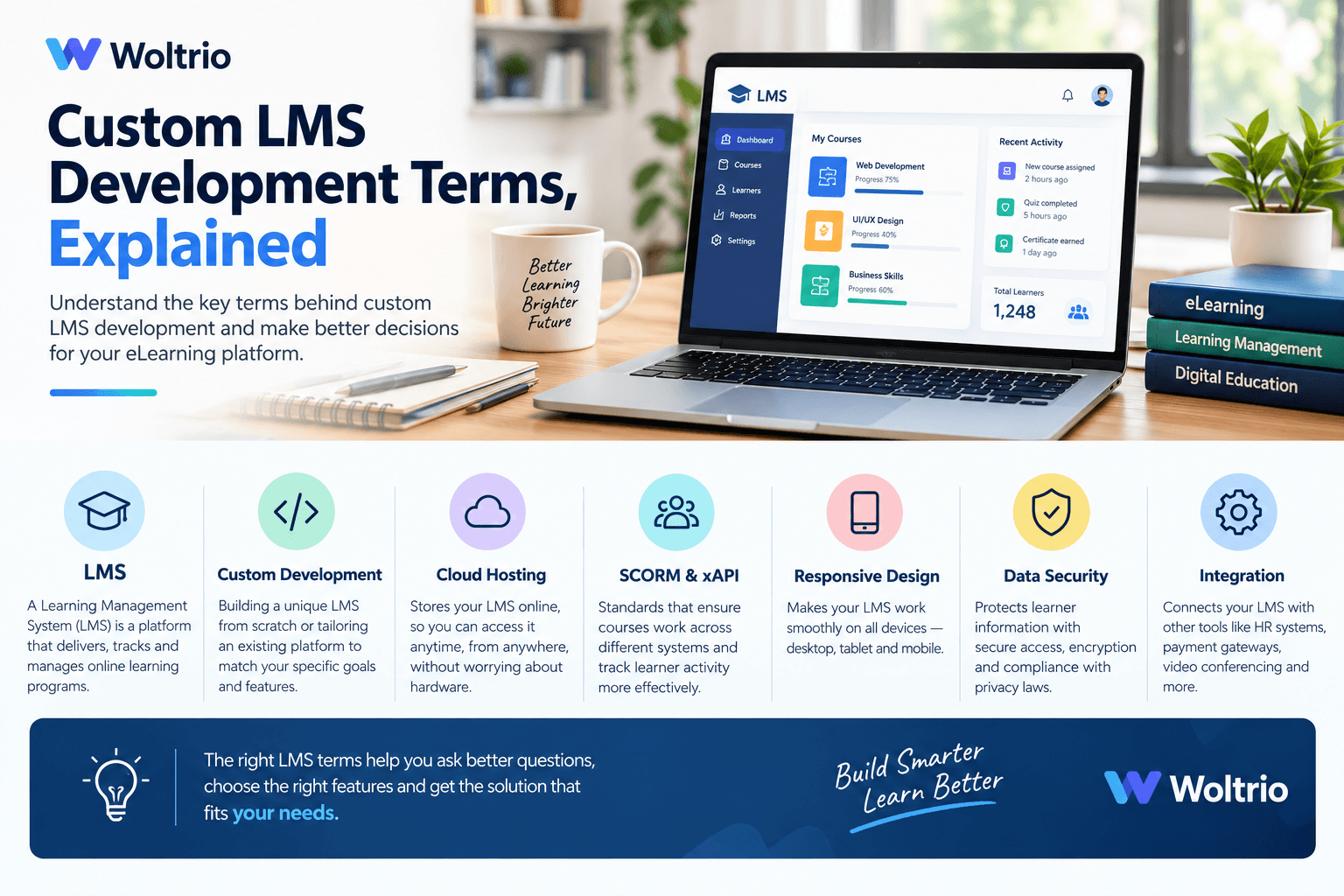
Vendor conversations about learning management system development move fast through acronyms that sound related but mean different things. This glossary breaks down the terms that come up most often, in plain language, so evaluating a custom LMS project doesn't require decoding jargon on the fly.
Content and Standards Terms
SCORM (Sharable Content Object Reference Model)
The older, widely used standard for packaging e-learning content so it can be tracked by an LMS, completion status, score, time spent. Most existing course content on the market is built to this standard, which matters if an organization has existing training material it wants to reuse in a new system.
xAPI (Experience API, also called Tin Can)
A newer, more flexible standard than SCORM for tracking learning activity, including activity that happens outside a traditional course, like a simulation or an on-the-job task. Custom LMS solutions built around xAPI can track a wider range of learning behavior than SCORM alone allows.
LRS (Learning Record Store)
The system that actually stores xAPI data. Some custom LMS development projects include a dedicated LRS to track learning activity beyond standard course completion, which matters for organizations wanting more nuanced training analytics than pass/fail course records provide.
Microlearning
Short, focused training modules, often a few minutes long, rather than lengthy courses. Increasingly common in healthcare and enterprise training because shorter modules tend to see higher completion rates than long, infrequent ones.
Cohort
A group of learners progressing through training together, often used for scheduled or instructor-led components rather than fully self-paced content. Relevant when a custom LMS needs to support live sessions alongside self-paced modules.
Assignment and Workflow Terms
Role-Based Assignment
Training automatically assigned based on a staff member's role or department, rather than manually assigned by an administrator. This is one of the areas where custom LMS development typically adds the most value, since generic assignment logic rarely matches an organization's actual role structure well.
Learning Path
A sequenced set of courses or modules a learner moves through, often tied to onboarding or certification progression. Custom learning paths can branch based on role, prior completion, or assessment results, which generic systems often handle less flexibly.
Recertification Cycle
The recurring schedule on which a certification needs to be renewed, common in healthcare and other regulated fields. This is frequently one of the most organization-specific pieces of a custom LMS development project, since generic systems built for general corporate training don't always model recurring, role-specific renewal cycles well.
Prerequisite
A course or requirement that must be completed before a learner can access another one. Useful for enforcing training sequences, like requiring a foundational safety module before advanced certification content becomes available.
Integration Terms
SSO (Single Sign-On)
Letting staff log into the LMS using the same credentials as other organizational systems, rather than a separate LMS-only login. Widely considered a foundational decision rather than an optional convenience, since separate logins create friction and account drift over time.
HRIS (Human Resources Information System)
The system storing core staff records, hire dates, roles, departments. Integration between an LMS and HRIS keeps training assignments and records accurate as staff details change, and it's often the single largest driver of both cost and timeline in a custom LMS development project.
API (Application Programming Interface)
The technical connection point that lets an LMS exchange data with other systems, HR platforms, identity providers, communication tools. When a vendor says a system is "integration-ready," ask specifically what APIs are available and what they actually expose.
Reporting and Compliance Terms
Audit Trail
A record of who accessed or changed training records, and when. Important for both general data security and for producing evidence during a compliance review.
Completion Record
The stored evidence that a specific learner finished a specific piece of training, typically including a timestamp and, where relevant, a score. This is the underlying data any compliance report ultimately depends on.
Compliance Reporting
The ability to generate reports, often on demand, showing training completion, certification status, and other data in a format that satisfies an audit or accreditation review. Custom LMS solutions are often built specifically to produce this in the exact format an organization's compliance team actually needs, rather than a generic export requiring manual rework.
Terms Worth Asking Vendors to Define Specifically
Some phrases show up often without much specific meaning behind them until pressed:
"Fully customizable" without specifying which layers, workflow logic, or just visual branding
"AI-powered" without naming what the AI actually automates
"Enterprise-ready" without specifics on scale, integration depth, or support model
"Compliant" stated generally, without naming which framework, HIPAA, SOC 2, or otherwise, and how
None of these phrases are automatically misleading, but a vendor who can get specific when asked is telling you something different from one who can't.
Why These Terms Matter Before Scoping a Project
Understanding this vocabulary makes it possible to have a precise conversation with a custom LMS development company rather than a vague one. Knowing to ask about SCORM versus xAPI compatibility matters if existing course content needs to carry over. Knowing to ask specifically about HRIS integration and SSO matters because those decisions shape both cost and daily usability. And knowing what a real audit trail and compliance report actually require prevents a nasty surprise close to a regulatory review.
Woltrio's AI and automation services and UI/UX design work both get scoped using this same vocabulary during discovery, specifically so a project's technical decisions are understood in plain terms by everyone involved, not just the engineering team. Organizations wanting to test specific integration terms in practice, like SSO or HRIS sync, before a full build often start with MVP development.
Quick Answers
SCORM and xAPI are both content tracking standards; xAPI is newer and tracks a broader range of learning activity than SCORM.
SSO and HRIS integration are foundational architecture decisions in custom LMS development, not optional add-ons.
A recertification cycle is often the most organization-specific workflow element in a custom LMS project, especially in regulated fields.
A compliance report depends entirely on the accuracy of underlying completion records, not just the reporting dashboard.
Vague vendor phrases like "fully customizable" or "AI-powered" are worth pushing for specifics on before signing anything.
Common Questions
Do we need to choose between SCORM and xAPI for a custom LMS?
Not necessarily. Many custom LMS solutions support both, especially if existing SCORM content needs to be reused alongside newer, more flexible tracking.
Is SSO always necessary for a custom LMS?
It's strongly recommended for most organizations, since separate logins create friction and long-term data drift between HR and LMS records.
What's the most important integration term to ask a vendor about directly?
HRIS integration. It's typically the largest driver of both cost and long-term data accuracy in a custom LMS development project.
Next Step
A discovery conversation through the Woltrio homepage is a good place to apply this vocabulary to a specific organization's actual LMS needs.