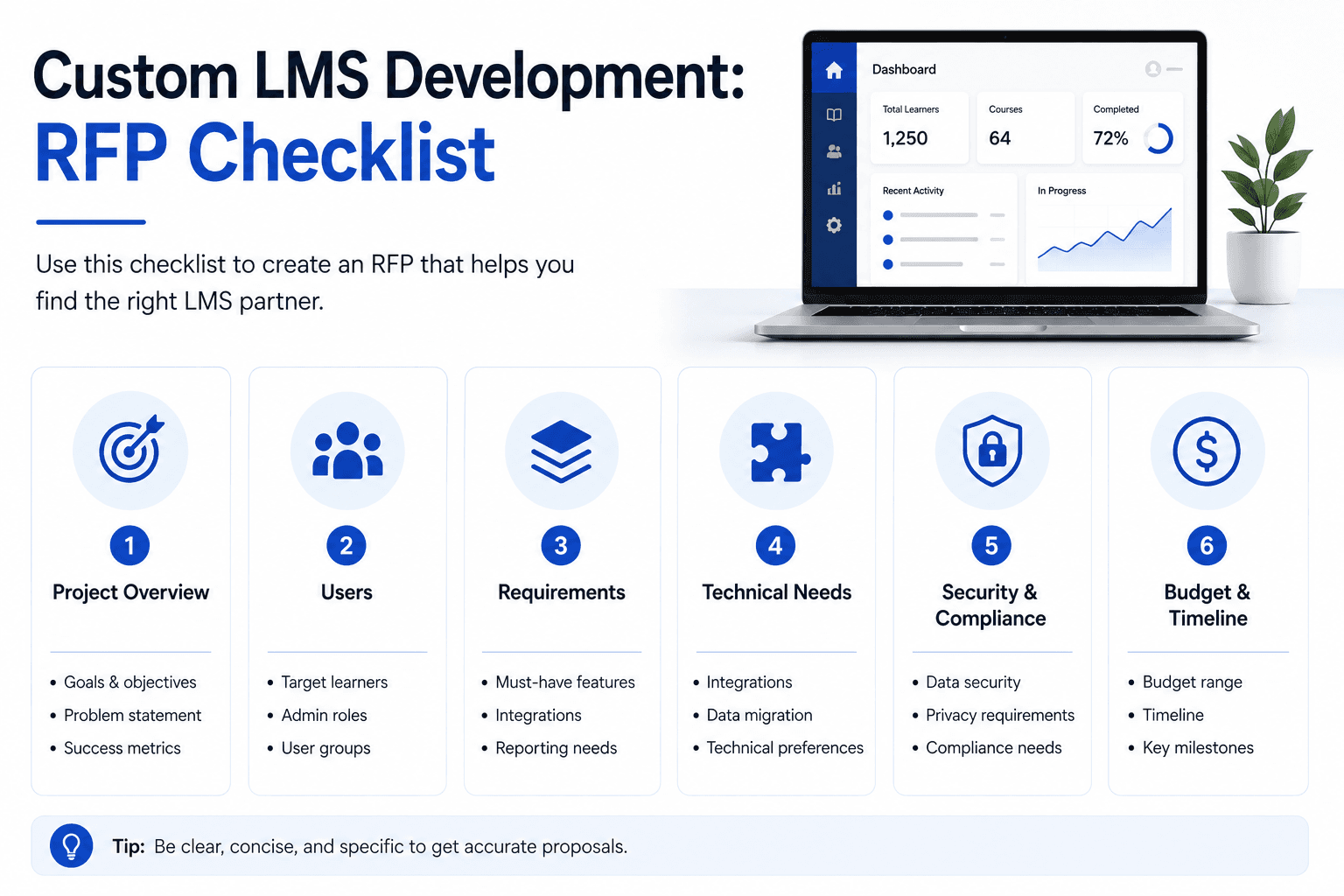
Most LMS vendor proposals look reassuring on paper. The gap between a good proposal and a good system usually shows up in the specifics nobody asked about during evaluation. This checklist covers the questions worth asking directly, organized by the area they protect against going wrong later.
Integration Questions
1. How will the LMS authenticate users?
Get a specific answer: single sign-on through your existing identity provider, or a separate login system. A separate login is a friction point staff will feel every day.
2. How does the LMS sync with our HR system, and how often?
Real-time sync, nightly batch sync, and manual export are three very different answers with very different implications for data accuracy.
3. What happens to LMS access when someone changes roles or leaves the organization?
This should be automatic, tied to the HR sync above. If the answer involves someone manually updating LMS permissions, that's a gap waiting to cause a problem.
4. Can the system integrate with tools we already use for scheduling or communication?
Not always necessary, but worth knowing whether it's possible before assuming it isn't.
Workflow and Assignment Questions
5. How does course assignment actually work, is it automatic based on role and department, or manual?
Manual assignment at scale becomes its own part-time job. Ask for specifics on how automatic assignment logic is configured, not just whether it exists.
6. Can assignment rules handle role changes and certification renewal cycles specific to our organization?
Generic assignment logic built for standard corporate training doesn't always handle healthcare-specific certification cycles well. Ask directly if this has been done before, not just whether it's theoretically possible.
7. What happens when course content gets updated, does it automatically reassign to staff who need the new version?
This is a common gap in less mature systems, content gets updated but staff who already "completed" the old version never see the new one.
Compliance and Data Questions
8. Can the system generate an audit-ready compliance report on demand, in the format we actually need?
Ask to see a sample report, not just a description of reporting capability. What sounds comprehensive in a sales conversation sometimes isn't in the format compliance actually requires.
9. How is patient-adjacent or sensitive staff data protected?
Expect a specific answer covering encryption at rest and in transit, role-based access controls, and audit trails, not a general assurance. Woltrio builds HIPAA, SOC 2, and GDPR requirements, where relevant, into LMS architecture from the start of every custom LMS development project.
10. Will the vendor sign a business associate agreement if patient-adjacent data is involved?
A vendor unwilling to sign a BAA when one is warranted is a serious red flag, not a negotiable detail.
Design and Adoption Questions
11. Who was involved in designing the interface, just administrators, or actual end users completing training?
Systems designed only from the administrator's perspective tend to have low completion rates, regardless of how good the reporting looks.
12. Can we pilot with one department before a full rollout?
A vendor resistant to a pilot phase is optimizing for a faster sale, not a better outcome. Woltrio treats a pilot as standard practice for exactly this reason.
Cost and Timeline Questions
13. What's included in the initial cost, and what becomes a change order later?
Ask this directly. Vague proposals often become expensive once features assumed to be included turn out not to be.
14. What's the realistic timeline given our specific integration needs, not a generic estimate?
A timeline given before integration needs are actually understood is a guess. Expect it to firm up after discovery, not before.
15. What does support look like after launch, and for how long?
Understand whether post-launch support is a defined period, an ongoing relationship, or something billed separately as issues come up.
How to Use This Checklist
Send these questions to every vendor under consideration before the proposal stage, not after. Vague or evasive answers to the integration and compliance sections in particular are worth taking seriously, since those are the areas most likely to cause real problems if left unaddressed. A vendor who answers all fifteen with specifics, rather than reassurance, is telling you something about how the actual project will go.
Organizations wanting to test a vendor's approach before committing to a full build often start with MVP development, validating identity integration and one workflow before signing off on the complete project.
What a Strong Vendor Answer Looks Like
A strong answer to "how does the LMS sync with our HR system" names a specific method and frequency, not just "yes, it integrates." A strong answer to the compliance question names HIPAA, SOC 2, or GDPR specifically and explains how, not just states that the system is compliant. Woltrio's AI and automation work, for example, gets described in terms of what specific tasks it automates, not a general "AI-powered" claim without detail.
Quick Answers
Fifteen key RFP questions cover integration, workflow logic, compliance, design, and cost, the areas most likely to cause problems if skipped during vendor evaluation.
Vague answers on HR integration or compliance are the biggest red flags to watch for during vendor selection.
A vendor resistant to a pilot phase before full rollout is optimizing for a faster sale over a better outcome.
Timeline estimates given before discovery are guesses; a real timeline should firm up after integration needs are understood.
Common Questions
Should we send this checklist to vendors before or after receiving proposals?
Before, ideally. Vendor responses to these questions should shape the proposal, not be an afterthought to it.
What's the single most important question on this list?
The HR and identity integration questions tend to matter most, since gaps there create ongoing friction that's hard to fix after launch.
Is it reasonable to ask for a sample compliance report before signing?
Yes. A vendor confident in their reporting capability should be able to show a sample without hesitation.
Next Step
A discovery conversation through the Woltrio homepage is a practical way to walk through this checklist directly against a specific organization's needs.