HomeHealth TechPatient Portal Software

Patient Portal Software Development

A modern patient portal is the digital front door to your healthcare organization — and patients expect more than lab result PDFs and appointment request forms. We build branded, HIPAA-compliant patient portals with real-time health record access, self-service scheduling, secure provider messaging, online bill pay, telehealth visits, and personalized health programs that keep patients engaged between clinical encounters.

90%+
Patient portal adoption in top-performing practices
30%
Reduction in inbound phone calls with self-service portal
FHIR R4
Health records access standard built-in
21st Century Cures
Information blocking compliance built-in

The Portal Your Patients Actually Log Into

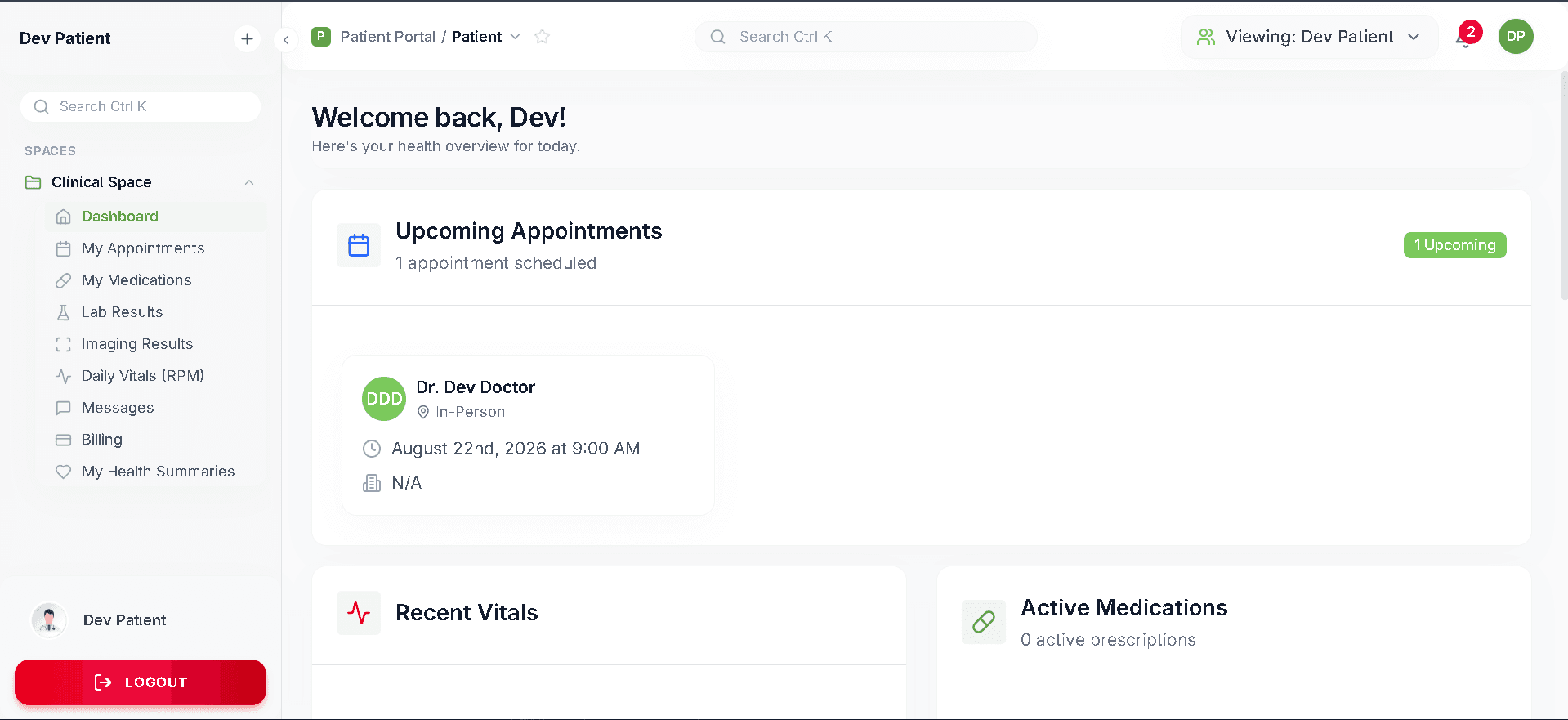
Appointments, medications, lab and imaging results, daily vitals, messages, and billing — on one screen a patient understands without being trained. Adoption follows clarity, and clarity is what turns a compliance checkbox into a portal people use.

  • Everything a patient needs is one click from the dashboard — no nested menus to learn.
  • Records, vitals, and results are pulled live from the EHR via FHIR R4, not re-keyed.
  • Self-service scheduling, messaging, and billing are what remove the inbound phone calls.
Patient portal software dashboard showing upcoming appointments, recent vitals, and active medications
A patient's home view: the next appointment with the provider and time, alongside recent vitals and active prescriptions.

A Patient Portal That Drives Engagement, Not Just Compliance

Most patient portals exist to satisfy Meaningful Use or 21st Century Cures compliance requirements. We build portals that patients actually want to use — because high adoption delivers measurable clinical and operational outcomes beyond the regulatory checkbox.

Health Records & Results Access

Real-time access to visit summaries, lab results, imaging reports, medication lists, immunization records, and care plans — delivered via FHIR R4 and compliant with 21st Century Cures information blocking rules. Patients can download, share, and contribute to their own record.

Self-Service Scheduling

Patient-facing appointment booking with real-time provider availability, appointment type selection, insurance verification at booking, automated reminders, and self-service cancellation and rescheduling — reducing scheduling call volume by up to 50%.

Secure Provider Messaging

HIPAA-compliant two-way messaging between patients and care team members — question routing to appropriate staff, attachments for photos and documents, read receipts, and message threading organized by clinical topic.

Everything Patients Need In One Secure Portal

A comprehensive patient portal reduces administrative burden, improves care coordination, and keeps patients actively engaged in their health journey.

HIPAA CompliantFHIR R421st Century CuresHL7 v2Mobile AppsWhite-LabelHITRUST Certified
21st Century Cures Act (Information Blocking)Compliant
ONC USCDI v3 Data StandardsCompliant
HIPAA Privacy & Security RuleCompliant
FHIR R4 Patient Access APIImplemented
Meaningful Use / Promoting InteroperabilitySupported
ADA Web Accessibility (WCAG 2.1 AA)Compliant
HITRUST CSF CertificationCertified
PCI DSS Level 1 (Payment Security)Compliant

View itemized statements, review insurance EOBs, set up payment plans, and pay balances online via Stripe — reducing accounts receivable days and eliminating paper statement costs.

Why Healthcare Systems Build Portals with Woltrio

A patient portal is only valuable if patients use it. We build engagement-first portals that combine consumer-grade UX with the clinical depth and compliance requirements that healthcare demands.

Consumer-Grade UX

We design patient portals with the same UX standards as top consumer apps — intuitive navigation, accessible design (WCAG 2.1 AA), and delight-driven interactions that make patients want to return.

Deep EHR Integration

Bidirectional FHIR integration with Epic MyChart, Cerner Patient Portal, Athenahealth, and others — patients see a unified view of their entire health record regardless of which EHR their providers use.

Measurable Engagement Outcomes

We instrument every portal feature with behavioral analytics — message response rates, appointment completion rates, bill pay adoption, result acknowledgment — so you can continuously improve adoption and outcomes.

Our Patient Portal Development Process

  1. 01

    Patient Journey Mapping

    Interview patients and clinical staff to understand current portal pain points, unmet needs, and the digital touchpoints that matter most to your population.

  2. 02

    FHIR Architecture & Compliance Planning

    Design FHIR R4 data access patterns, 21st Century Cures compliance strategy, HIPAA security architecture, and EHR integration approach.

  3. 03

    Portal Development

    Build health records, scheduling, messaging, billing, and telehealth modules in agile sprints with continuous stakeholder review.

  4. 04

    Usability Testing & Accessibility Audit

    Conduct usability testing with real patients across demographics, validate WCAG 2.1 AA accessibility compliance, and refine UX based on findings.

  5. 05

    Launch & Adoption Campaign

    Execute phased launch with patient outreach, staff training, and an adoption analytics dashboard tracking enrollment and feature engagement.

Frequently
Asked Questions

Seeking basic information? Our FAQ section is a ready reckoner with precise answers to the most probable queries.

What is a patient portal?

A patient portal is a secure, HIPAA-compliant online application that gives patients 24/7 access to their health information and enables digital communication with their healthcare providers. Core features include access to medical records, lab results, and visit summaries; appointment scheduling and reminders; secure provider messaging; online bill pay; prescription refill requests; and — in modern portals — telehealth visits, digital intake forms, and health education content. Patient portals are central to patient engagement strategies and are required components of ONC Promoting Interoperability certification.

Is a patient portal required by law?

Under the 21st Century Cures Act and ONC's Information Blocking Rule, healthcare providers that use certified EHR technology are required to provide patients with timely electronic access to their health information without blocking or impeding access. This effectively mandates a patient-facing digital access mechanism. Additionally, the ONC's FHIR-based Patient Access API rule requires health plans and providers to make patient data available via FHIR R4 APIs — which a patient portal can surface. Practices pursuing Promoting Interoperability (formerly Meaningful Use) incentive payments also have specific portal utilization thresholds to meet.

How does your patient portal integrate with Epic or Cerner?

We integrate via FHIR R4 APIs — Epic provides FHIR access through Epic App Orchard; Cerner through its open FHIR platform. Integration pulls clinical data (conditions, medications, allergies, labs, immunizations, care plans) in near real-time and supports write-back for patient-generated health data, appointment requests, and secure messages. For deeper integration (scheduling directly into the EHR's appointment book, writing clinical notes back), we work with Epic's SDKs and Cerner's CDS Hooks framework.

Can the portal support multiple health systems or practices?

Yes. We build multi-organization portals where patients can connect to multiple healthcare organizations from a single unified login — seeing records from their primary care physician, specialist, and hospital system in one view, each powered by the respective organization's FHIR API. For health system clients, we also support multi-site portals where patients select their location-specific experience while the platform provides centralized analytics and governance.

What security measures protect patient data in the portal?

Patient portal security starts with HIPAA-compliant authentication — unique user accounts with multi-factor authentication (SMS OTP, authenticator app, or biometric on mobile), session timeouts, and secure account recovery. Data at rest is encrypted with AES-256; data in transit uses TLS 1.3. Role-based access ensures patients only see their own records, and all PHI access is logged in an immutable audit trail. Penetration testing is conducted before launch and annually thereafter.

How do you maximize patient adoption of the portal?

Portal adoption is driven by delivering genuine value and removing friction. Our approach combines strategic UX design (mobile-first, accessible, consumer-grade interface), a strong launch activation campaign (enrollment prompts at every patient touchpoint — check-in, discharge, SMS campaigns), and post-launch adoption analytics that identify and address drop-off points. We also build in proactive push notifications for new results, appointment reminders, and health program nudges that give patients a reason to return regularly.

How much does it cost to build custom patient portal software?

Cost depends on scope and depth of EHR integration. A focused portal MVP — health records access, scheduling, and secure messaging against a single EHR — typically runs in the low-to-mid six figures. A full enterprise portal with billing, telehealth, native mobile apps, and multi-EHR integration scales up from there. We provide an exact estimate after scoping your patient population, EHR landscape, and required compliance certifications (HITRUST, SOC 2) during discovery.

What's the difference between a patient portal and a patient engagement platform?

A patient portal is the secure, HIPAA-compliant application itself — the login, the health records view, the messaging inbox. A patient engagement platform is the broader strategy layer built on top of it: automated outreach campaigns, satisfaction surveys, behavioral analytics, and personalized health nudges that drive adoption and retention. We build the portal as the foundation and layer in engagement tooling — reminders, feedback collection, adoption dashboards — so the two work as one system rather than separate products.

Ready to Build Your Healthcare Software.

Let's discuss your project requirements and build something that delivers real clinical and business value.

Powering Your Solutions With

Python
Selenium

React Native
HL7 FHIR
Flutter
TypeScript
Flutter
Python
Selenium
React Native
HL7 FHIR
TypeScript
Python
Selenium
React Native
HL7 FHIR
Flutter
TypeScript
Flutter
Python
Selenium
React Native
HL7 FHIR
TypeScript