
























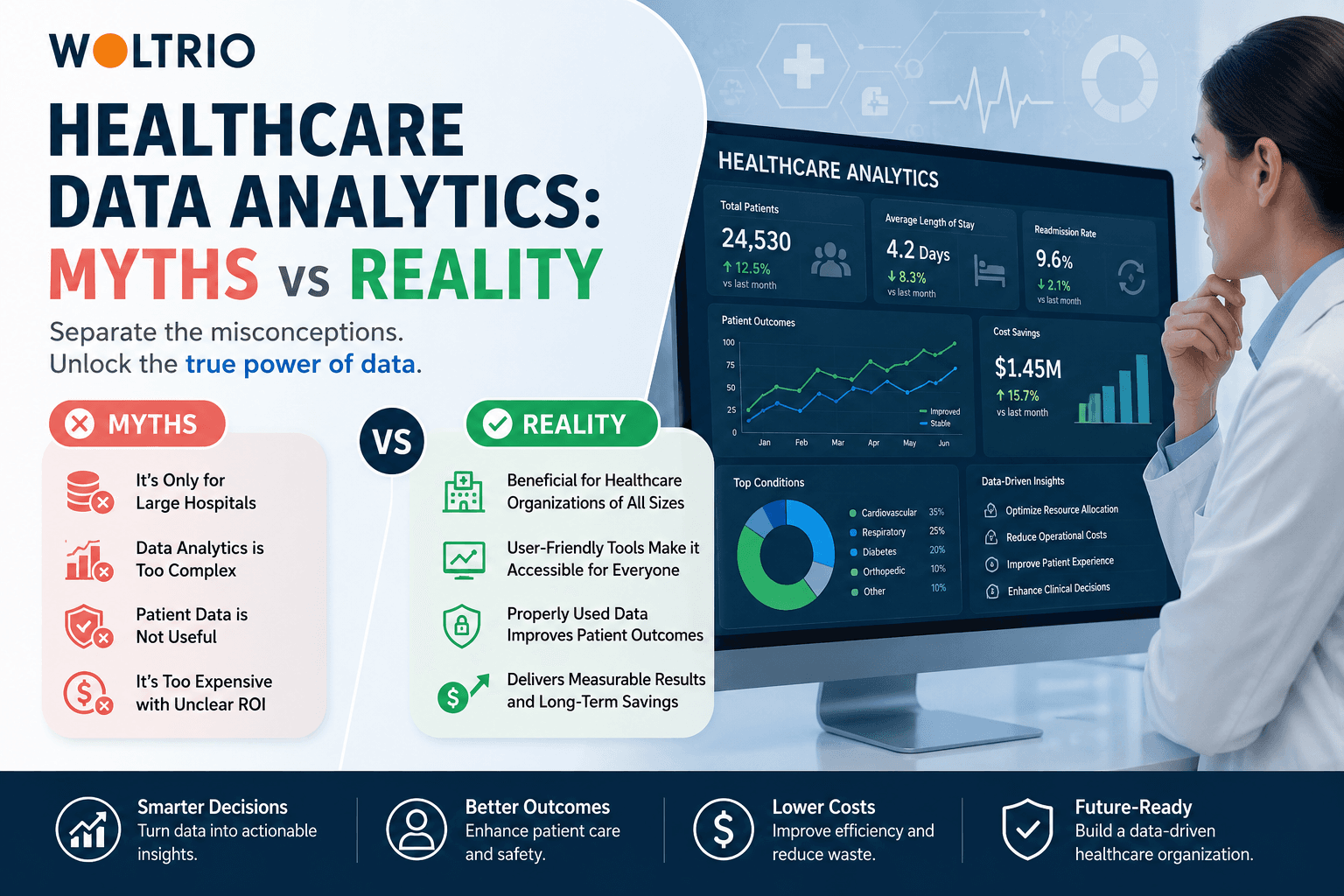
Myth 1: More Data Automatically Means Better Insight
Reality: a clinical analytics platform pulling from ten data sources isn't automatically more useful than one pulling from three. More data without a clear question behind it just produces more dashboards nobody checks. The systems that actually get used start from specific decisions, staffing on a given unit, readmission risk for a specific population, and build backward to the data needed, instead of dumping every available dataset into a warehouse and hoping something useful surfaces.
Woltrio builds healthcare data analytics around defined use cases first, which is a different starting point than most off the shelf platforms take.
Myth 2: A Healthcare Analytics Platform Is a Single Product You Buy
Reality: most successful analytics setups are closer to three connected layers than one product. Data has to be pulled cleanly from EHRs, billing systems, and other sources through HL7 or FHIR. It has to be normalized so a "readmission" means the same thing across every source. And only then does a dashboard or predictive model sit on top. Buying a slick front-end without solving the first two layers is why so many analytics tools look great in a demo and go quiet within a few months.
Myth 3: Predictive Analytics Requires a Massive Data Science Team
Reality: useful predictive models in clinical analytics don't require a ten-person data science department. Many high-value use cases, readmission risk, no-show prediction, staffing forecasts, run on well-scoped models built around a specific question, not a research-grade general-purpose AI system. Woltrio's AI and automation services focus on exactly this kind of scoped model, built to answer one operational question well rather than everything poorly.
Myth 4: Real-Time Dashboards Are Always Worth the Investment
Reality: real-time data is expensive to build and maintain, and plenty of decisions don't actually need it. Staffing decisions for next week don't need second-by-second updates. Daily or even weekly refreshes are often enough, and cheaper to build reliably. Real-time matters for a smaller set of use cases, like ICU monitoring or active outbreak tracking, where a delay genuinely changes an outcome. Knowing which category a use case falls into avoids paying for infrastructure that adds cost without adding value.
Myth 5: Clinicians Will Use Whatever Analytics Tool IT Rolls Out
Reality: adoption is the single biggest reason healthcare analytics platforms fail after launch, not technical limitations. A dashboard that requires five clicks to answer a simple question gets abandoned within weeks, regardless of how sophisticated the model behind it is. Woltrio's UI/UX design work treats the interface as part of the analytics project, not an afterthought bolted on once the backend is done.
What a Clinical Analytics Platform Actually Needs to Work
Stripping away the myths, a working system needs four things in place:
A clean, connected data layer. Reliable HL7 v2/v3 or FHIR integration so data flows in consistently, not through manual exports.
A small number of well-defined use cases. Two or three specific decisions the analytics needs to support, not an open-ended "give us insights" mandate.
Models scoped to the question. Purpose-built, not an oversized general AI system applied to a narrow problem.
An interface people will actually open. Fast to load, answers the question in a glance, and fits into an existing workflow instead of requiring a separate login and habit.
How Woltrio Approaches a Healthcare Analytics Project
Most engagements start with discovery to identify the two or three decisions the analytics platform actually needs to support, since that scope decision shapes everything downstream. From there, the data integration layer gets built against existing systems using HL7 or FHIR, models get scoped to the defined use cases rather than built generically, and the interface gets designed around how staff will actually check it day to day. Practices or health systems wanting to test the concept before a full build often start with MVP development, proving out one use case, like readmission risk flagging, before expanding further.
HIPAA and Security Still Apply
Healthcare data analytics touches the same protected health information as any clinical system, so the same requirements apply: encryption at rest and in transit, role-based access controls, audit trails, and signed agreements with any vendor or tool in the data pipeline. Woltrio builds HIPAA, SOC 2, and GDPR requirements, where relevant, into the analytics architecture from the start rather than treating compliance as a separate downstream concern.
Quick Answers
Healthcare data analytics works best when built around two or three specific decisions, not an open-ended data dump.
A clinical analytics platform is really three layers: clean data integration, scoped models, and an interface people actually use.
Predictive analytics doesn't require a large data science team when the model is scoped to a specific, well-defined question.
Real-time data is only necessary for a subset of use cases; many decisions work fine on daily or weekly refreshes.
Adoption, not technical capability, is the most common reason healthcare analytics platforms go unused after launch.
Common Questions
Why do so many healthcare analytics platforms go unused after launch?
Usually because they were built around available data instead of specific decisions, and because the interface adds friction instead of fitting into existing workflows.
Does a clinical analytics platform need real-time data to be useful?
Only for a smaller set of use cases like ICU monitoring. Most operational and staffing decisions work well with daily or weekly data refreshes.
How long does it take to build a healthcare data analytics platform?
A single scoped use case can often launch in a few months; a multi-use-case platform with deeper integration takes longer.
Do we need a data science team to use predictive analytics?
No. Well-scoped models built around a specific question can be developed without an in-house data science department.
Next Step
A discovery conversation through the Woltrio homepage usually clarifies which two or three use cases would actually move the needle before any platform gets built.