
























The Starting Point: A Vague Ask
Most healthcare data analytics projects start the same way: a hospital or clinic leadership team says some version of "we need better analytics" without a clear picture of what that means day to day. That vagueness isn't a failure on their part, it's normal. Most organizations know something is inefficient before they know exactly what to measure to fix it.
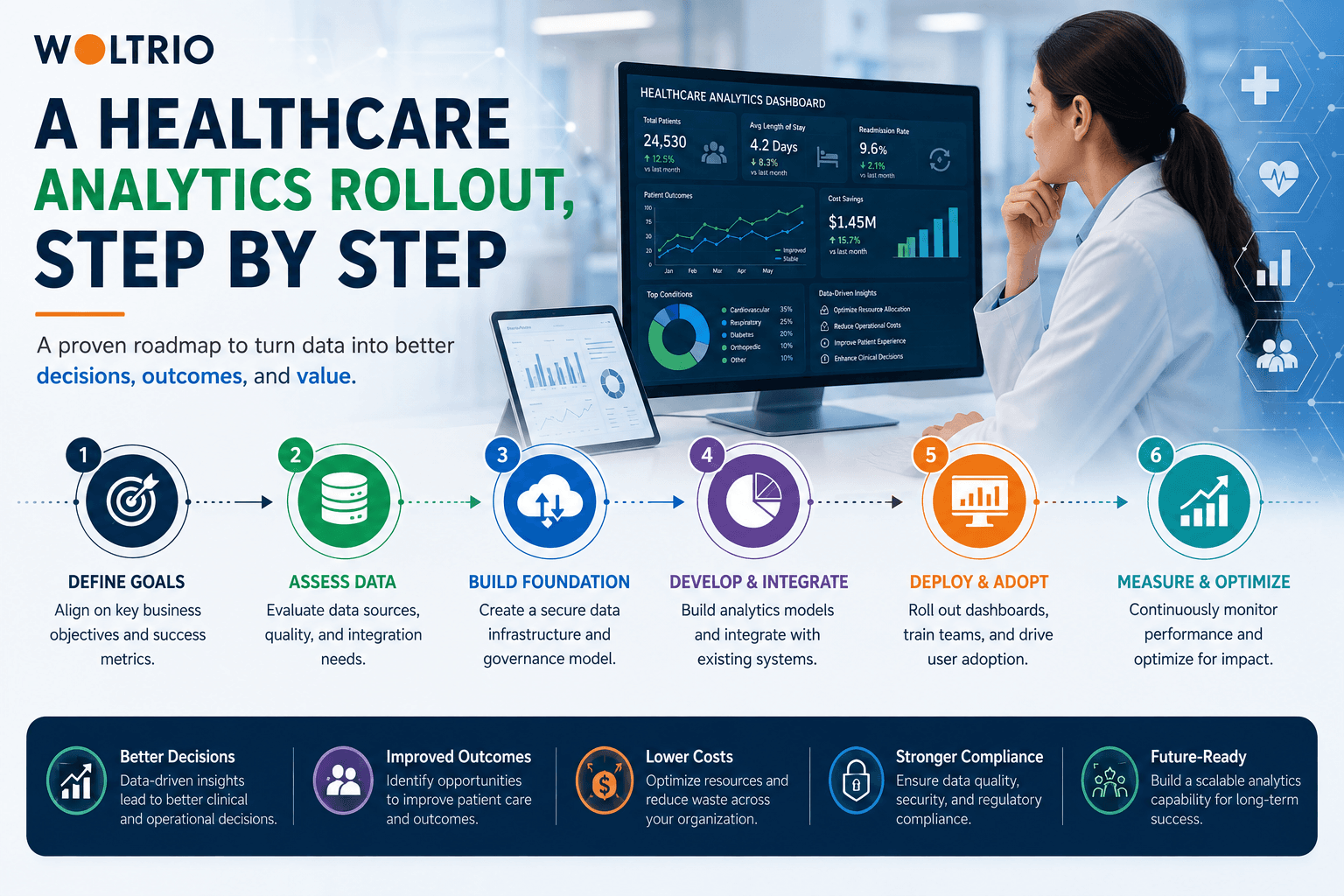
Here's how a typical engagement moves from that starting point to a working clinical analytics platform, using a representative mid-size health system scenario to illustrate each stage.
Week 1-2: Turning "We Need Analytics" Into Specific Questions
The first step isn't building anything, it's narrowing the ask. In a typical discovery phase, Woltrio works with clinical and operations leads to identify two or three decisions the analytics platform actually needs to support. In this scenario, that turned out to be: predicting 30-day readmission risk for a specific patient population, forecasting staffing needs by unit, and flagging no-show risk for scheduling.
That's a very different, and much more buildable, scope than "give us better analytics."
Week 3-6: Mapping the Data That Actually Exists
Before any model gets built, the data has to be assessed. In this scenario, patient records lived in the EHR, staffing data lived in a separate scheduling tool, and no-show history lived in yet another system, none of them talking to each other. This stage focused on building clean HL7 v2/v3 and FHIR connections so the three data sources could feed one consistent analytics layer, rather than three disconnected exports that someone would have to manually reconcile every week.
This is usually the least visible part of the project and also the part that determines whether everything after it actually works.
Week 7-12: Building Models Scoped to the Three Questions
With clean data flowing in, the next stage built three purpose-built models rather than one general-purpose system: a readmission risk score, a staffing forecast by unit and shift, and a no-show risk flag tied to individual appointment slots. Each model was scoped narrowly on purpose. A readmission model that also tries to predict fifteen other things tends to do all fifteen worse than three separate, focused models would each do one thing.
This is the kind of scoped work Woltrio's AI and automation services are built around, purpose-fit models rather than an oversized general system layered onto a narrow problem.
Week 10-14: Designing an Interface People Would Actually Open
In parallel with the modeling work, the interface got built around how staff would actually check it, a single view for charge nurses to see staffing forecasts for their unit, and a simpler flagged list for front desk staff to see which appointments carried elevated no-show risk. Neither required a new login system or a workflow change; both were designed to slot into checks staff were already doing. That design work followed Woltrio's UI/UX design approach of treating adoption as a design problem, not an afterthought.
Week 15-16: Launch, Training, and the First Real Numbers
Launch included short training sessions with the staff who'd actually use each dashboard, not a system-wide rollout email nobody reads. In a scenario like this, the readmission model typically starts producing usable risk scores within the first few weeks, staffing forecasts get compared against actual outcomes and refined over the following month, and no-show flagging starts showing measurable impact on overbooking decisions almost immediately, since it requires no new behavior, just a flag on an existing screen.
What Made the Difference
Looking back at a project shaped like this, three decisions tend to matter most: narrowing the scope to two or three questions instead of an open-ended analytics mandate, investing real time in the data integration layer before touching any model, and treating the interface as part of the deliverable rather than something bolted on at the end. Skip any one of those and the risk of an unused dashboard goes up sharply.
If a Full Rollout Feels Like a Lot
Not every organization needs to commit to all three use cases at once. Woltrio's MVP development approach exists for exactly this, proving out one use case, like no-show risk flagging, before expanding into staffing forecasts or readmission modeling.
Compliance Runs Underneath All of It
Every stage above assumes HIPAA-compliant handling of patient data throughout, encryption at rest and in transit, role-based access, audit trails, and signed agreements with any tool in the data pipeline. Woltrio builds these requirements, including HIPAA, SOC 2, and GDPR where relevant, into the architecture from the discovery phase rather than adding them once a model is already built.
Quick Answers
A healthcare data analytics rollout typically starts by narrowing a vague request into two or three specific, answerable questions.
Data integration, connecting EHR, scheduling, and other systems cleanly, usually takes longer than building the models themselves.
A clinical analytics platform works best with a small number of purpose-built models rather than one general-purpose system.
Interface design is a major factor in whether a healthcare analytics platform gets used after launch, not just the accuracy of the model.
Starting with one use case through an MVP is often a lower-risk path than committing to a full multi-model rollout upfront.
Common Questions
How long does a healthcare data analytics project typically take?
A single well-scoped use case can often launch in two to three months; a multi-use-case platform with deeper integration takes longer, often three to four months as outlined above.
What's the hardest part of building a clinical analytics platform?
Usually the data integration layer, connecting existing systems cleanly, not the predictive modeling itself.
Do all use cases need to launch at the same time?
No. Starting with one high-impact use case and expanding afterward is a common, lower-risk approach.
How is model accuracy measured after launch?
By comparing predictions against actual outcomes over the following weeks and refining the model based on that gap.
Next Step
A discovery conversation through the Woltrio homepage is the starting point for narrowing a broad analytics ask into a buildable set of use cases.