

























There is a finding in the clinical informatics literature that almost no analytics vendor will show you.
A health system built provider level quality dashboards inside Epic, tracking colorectal cancer screening and diabetes measures for primary care panels. They then measured whether the clinicians who actually looked at the dashboards improved more than the ones who did not. The correlation was 0.06 for one measure and negative 0.05 for the other. Both confidence intervals crossed zero. Viewing the dashboard predicted nothing.
That is not an argument against healthcare data analytics. It is an argument against the thing most organisations buy when they think they are buying analytics. The dashboard is not the deliverable. A changed decision is the deliverable, and the gap between those two is where most budgets disappear.
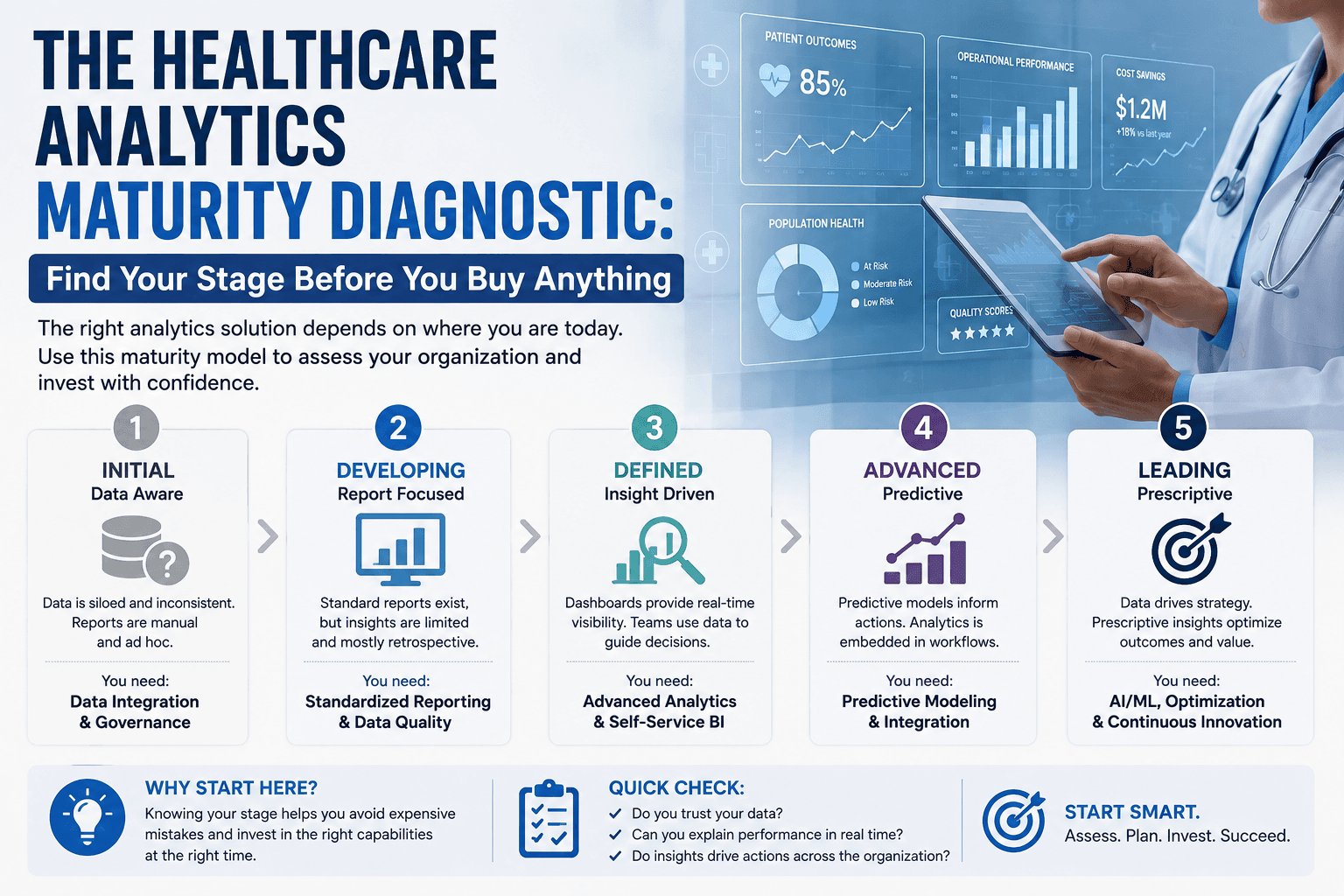
So before you evaluate a single healthcare analytics platform, work out which stage you are actually at. The stages below are diagnostic. Each one has a distinct symptom, a distinct real problem, and a distinct next build. Buying the wrong stage's solution is the most common and most expensive error in this category.
Five questions to place yourself
Answer honestly. Optimism here costs money later.
Can you produce the same number twice, from two different people, without a meeting?
When a number looks wrong, do you know within an hour whether it is wrong?
Does anyone change what they do because of a report, this week?
Can you trace a figure on a dashboard back to the source system field it came from?
If your main analyst left tomorrow, would reporting continue?
Count your yeses. Zero or one puts you at Stage 0. Two or three, Stage 1 or 2. Four, Stage 3. Five, and you are at Stage 4 and probably do not need this article.
Stage 0. The spreadsheet economy
Symptom. Numbers live in exports. Someone downloads from the source system, pastes into a spreadsheet, and reconciles by hand. Two people asked the same question give two different answers, and both are defensible.
What is actually wrong. Nothing technical. This is a definitions problem wearing a technology costume. Nobody has written down what a completed visit is, or which date stamps a readmission.
What to build. A data dictionary, in a document, before any software. Twenty to forty core definitions, signed off by the people who argue about them. This costs almost nothing and prevents the most expensive failure mode further up.
What not to do. Do not buy a healthcare analytics platform at this stage. It will faithfully reproduce your disagreements at higher speed and greater cost.
Stage 1. The pipeline exists, the trust does not
Symptom. You have automated extracts and a reporting tool. Nobody believes the output. Every leadership meeting starts with someone questioning a figure, and the meeting becomes about the number instead of the decision.
What is actually wrong. Data quality, specifically veracity. Missing fields, duplicate patient identities, and inconsistent coding corrupt outputs before they reach anyone clinical. This is where healthcare analytics programmes quietly lose money, because the failure is invisible until trust is already gone.
What to build. Validation and lineage before features. Automated quality checks on every load, a visible record of what each field came from, and a documented refresh cadence so people know how stale a number is. Woltrio treats this layer as non negotiable in backend development for analytics work, because everything above it inherits its credibility.
What not to do. Do not add more dashboards. More output from a distrusted pipeline lowers trust further.
Stage 2. The architecture question
Symptom. The data is trusted and the questions have outgrown the tooling. Queries are slow, unstructured data has nowhere to live, and every new source takes a quarter to onboard.
What is actually wrong. This is the one stage where the architecture genuinely is the bottleneck, and where the industry consensus is broadly right. Most health systems now converge on a lakehouse pattern, structured query performance for quality reporting alongside the flexibility to hold imaging, notes, and genomics for AI work. The 21st Century Cures Act requirement that EHR vendors support FHIR R4 APIs is what made this practical at all, by giving you a standard way in.
What to build. A platform decision, made deliberately, with FHIR native pipelines and an explicit cost model. Woltrio's cloud engineering work pairs the architecture with a spend ceiling from day one, because cloud makes overspending remarkably easy and the bill arrives after the architecture is fixed.
What not to do. Do not skip to this stage from Stage 0 or 1. A lakehouse built on undefined metrics and unvalidated data is an expensive way to be wrong faster.
Stage 3. The adoption gap
Symptom. The clinical analytics platform works. The data is right, the architecture holds, and usage is respectable. Outcomes have not moved.
What is actually wrong. This is the dashboard finding from the opening, and it is the least discussed stage in the entire category. Insight that arrives outside the workflow does not change behaviour. A clinician who has to leave a chart, open a separate tool, and interpret a chart will not do it during a clinic session, and looking at it afterwards changes nothing about the decision already made.
What to build. Delivery into the workflow rather than alongside it. The unit of value is a prompt at the point of decision, not a report at the end of the month. This is where workflow automation and targeted AI development earn their place, and where integration with the record system through custom EMR and EHR development stops being optional.
What not to do. Do not respond to low impact by building more views. The problem is placement, not volume.
Stage 4. Analytics as an operating habit
Symptom. Decisions have owners, metrics have definitions, and models get revalidated on a schedule. Nothing feels urgent.
What is actually wrong. Drift. Definitions rot as services change, models decay as populations shift, and a dashboard that was correct two years ago is now confidently wrong. Analytics treated as a finished project is the failure mode of this stage.
What to build. Ownership and revalidation cadence. Someone named for each metric, scheduled model review, and a retirement process for reports nobody opens.
What not to do. Do not assume maturity is permanent. Most organisations that reach Stage 4 slide back to Stage 1 after a merger or a platform change.
Why the stage matters more than the vendor
Almost every published comparison in this category assumes you are at Stage 2, because Stage 2 is the only stage where a platform purchase is the answer. That is not an accident. It is who writes the content.
If you are at Stage 0, a platform makes things worse. At Stage 1 it papers over a data quality problem you will meet again later. At Stage 3 it is already bought and not the constraint. At Stage 4 you need governance, not software. The healthcare analytics platform market is real and the products are good. They are just the answer to one question out of five.
A caution on the numbers you will encounter while researching this. Market sizing in healthcare data analytics varies wildly between sources, and a large share of the statistics circulating in 2026 originate in vendor marketing rather than research. Treat any figure without a named methodology as decoration.
Where Woltrio fits
Woltrio does not sell a healthcare analytics platform, which is the reason this article can be honest about when you do not need one.
Woltrio builds the parts a platform does not cover: the validation and lineage layer at Stage 1, the FHIR native pipelines and cost controlled architecture at Stage 2, and the workflow integration at Stage 3 where analytics either changes a decision or does not. Most engagements start with a short diagnostic rather than a proposal, because the stage determines the scope, and getting the stage wrong is the expensive part. Where the stage is genuinely unclear, a scoped MVP settles it faster than another round of vendor demos.
The question is not which clinical analytics platform is best. It is which decision you want changed, and what has to be true for that to happen.
Start with a scoped diagnostic from Woltrio.
Common questions
What is the difference between healthcare data analytics and a clinical analytics platform? Healthcare data analytics is the practice, covering definitions, pipelines, quality, and decision use. A clinical analytics platform is one product category inside it. Buying the platform does not deliver the practice, which is why Stage 0 and Stage 1 organisations often see no return from a purchase.
How do we know if our data quality is good enough to build on? Run the same question through two independent paths and compare. If the answers differ and nobody can explain why within an hour, you are not ready. Automated validation, field level lineage, and a documented refresh cadence are the minimum before anything is built on top.
Do we need a lakehouse? Only at Stage 2, and only if unstructured data is genuinely in scope. If your reporting is structured and your volumes are moderate, a warehouse is simpler and cheaper. The lakehouse pattern earns its complexity when imaging, clinical notes, or model training are part of the plan.
Why do dashboards so often fail to change outcomes? Because insight delivered outside the workflow rarely reaches the moment of decision. A clinician will not leave a chart mid consultation to interpret a report. Analytics that changes behaviour is usually a prompt inside the existing workflow, not a separate destination.
Should we build or buy a healthcare analytics platform? Buy the platform if you are at Stage 2 and your questions match what the market already models. Build the layers around it, validation, lineage, and workflow delivery, because those are specific to your definitions and your clinical processes and no vendor ships them for you.
PRODUCTION NOTES (not part of the article)
Format, and why this one
Third distinct structure across the four pieces.
Articles 1 and 2, HH template.
Article 3, analyst memo.
Article 4, this one, a diagnostic instrument.
The reader self scores against five questions, lands in a stage, and gets a symptom, a root cause, a build, and an explicit do not. The repeating four part sub structure is the whole point. It makes the piece scannable, quotable in AI answers, and genuinely usable rather than just readable.
Why a diagnostic rather than another explainer. Page one for these terms is almost entirely vendor content arguing that you need a platform, mostly from companies that sell one. Woltrio does not sell a platform, so the credible position is the one nobody in that SERP can take: telling people when not to buy. That is also the strongest possible qualification filter for inbound leads.
The anchor finding, and how hard it is
The opening study is real and worth understanding before you publish. A health system built PCP quality dashboards in Epic for colorectal cancer screening and diabetes measures, then correlated dashboard views against quality score improvement. Correlations were 0.06 and negative 0.05, both confidence intervals crossing zero. The authors concluded dashboards alone may not be sufficient for quality improvement.
Two caveats to hold. It is a single health system retrospective analysis, not a trial, and it is not recent. It supports the claim that viewing a dashboard does not predict improvement. It does not prove analytics fails generally, and the article does not claim that. If a client pushes back, that distinction is the honest answer.
Statistics I deliberately did not use
A 40 percent implementation cost increase figure from choosing the wrong architecture. Sourced to a vendor blog with no methodology. Unusable.
A 73 percent cloud storage adoption figure. Dates to 2022, too old to present as current.
Healthcare analytics market sizing. Sources disagree substantially and much of it traces to marketing. I referenced the unreliability itself instead, which is more defensible and more useful.