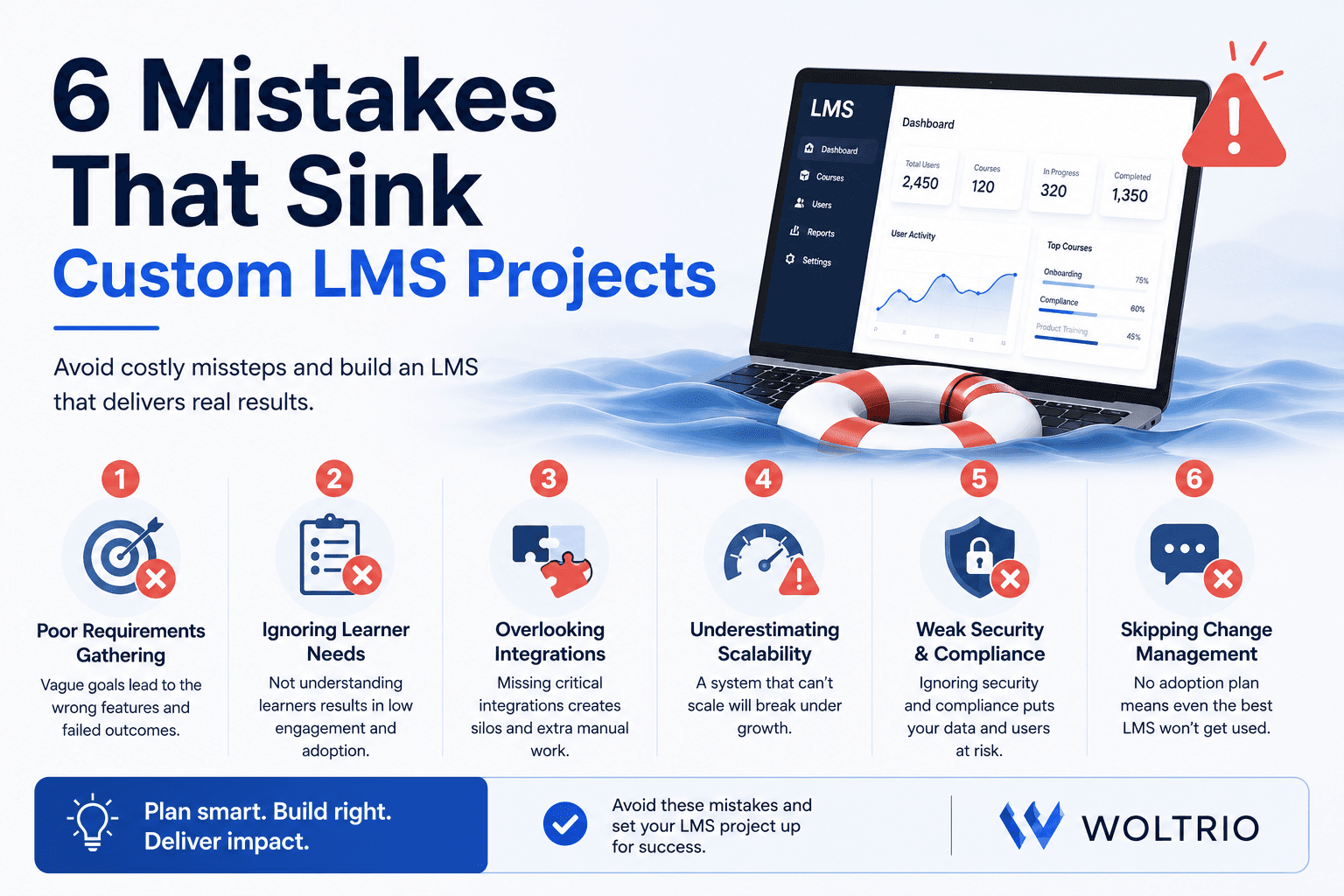
Most failed LMS projects don't fail during development. They fail months earlier, during decisions nobody flagged as risky at the time. Here are the six mistakes that show up most often in custom LMS development projects, and what avoiding each one actually looks like in practice.
Mistake 1: Building the Course Catalog Before Mapping the Workflow
It's tempting to start a learning management system development project by organizing content, courses, modules, categories. But content structure decided before anyone maps how staff actually move through onboarding, recurring training, and certification renewals tends to produce a catalog that looks organized and functions poorly.
What to do instead: Map the actual training journey first, who gets assigned what, when, and based on what trigger, role change, hire date, certification expiration, before touching course structure. Woltrio starts every custom LMS solutions project with this workflow mapping specifically to avoid retrofitting structure onto content that was organized without it.
Mistake 2: Treating Identity and HR Integration as a Later Configuration Step
A learning management system that requires a separate login from every other tool staff already use is fighting an uphill battle before day one. Worse, when the LMS doesn't sync with HR records, someone ends up manually updating two systems every time a new hire starts or a role changes, and those two systems drift apart within months.
What to do instead: Decide how the LMS will authenticate, single sign-on through an existing identity provider, and how it will sync with HR data, during architecture planning, not after the interface is built. Woltrio's MVP development approach often tests exactly this integration early, validating single sign-on and one HR data sync before the rest of the system gets built around it.
Mistake 3: Designing for the Person Assigning Training, Not the Person Taking It
A lot of custom LMS development gets scoped through conversations with training managers and administrators, which makes sense, they're often the ones commissioning the project. But if nobody sits down with the actual staff completing the training, courses, the interface ends up optimized for assignment and reporting, and merely tolerable for the people who have to use it every week.
What to do instead: Include frontline staff in design review, not just leadership. Woltrio's UI/UX design process treats the end learner's experience as a primary design input, not a secondary consideration after the admin dashboard is finalized.
Mistake 4: Underestimating What Compliance Reporting Actually Needs to Look Like
Compliance officers often get consulted late in LMS planning, after the system's basic structure is already decided. Then, close to launch, it becomes clear the reporting format doesn't match what's actually needed for an audit or accreditation review, certification expiration dates aren't tracked the right way, or completion records can't be exported in the format a regulator expects.
What to do instead: Bring compliance requirements into scope during discovery, not validation. Any custom LMS development company worth working with should ask specifically what an audit-ready report needs to contain before writing a line of code, not after a mock audit reveals the gap.
Mistake 5: Skipping a Pilot and Launching to Everyone at Once
A full organization-wide LMS rollout is a lot to absorb at once, both for staff learning a new system and for whoever's fielding the inevitable early questions. Launching everywhere simultaneously means problems surface everywhere simultaneously too, at the worst possible scale.
What to do instead: Pilot with one department or one training track first. Problems that show up with fifty users are far easier to fix than the same problems showing up with five hundred. This is also where AI and automation, like automated completion reminders, gets validated on a smaller scale before being trusted organization-wide.
Mistake 6: Assuming "Custom" Means Building Everything From Scratch
Some organizations assume custom LMS solutions means reinventing every piece of functionality, which drives up cost and timeline without necessarily improving the result. Course delivery mechanics, video playback, quiz logic, don't usually need to be reinvented. What actually needs to be custom is the workflow logic, integration, and reporting that's specific to the organization.
What to do instead: Be clear during scoping about what genuinely needs custom development versus what can use proven, existing approaches. A learning management system development company that pushes to custom-build everything regardless of need is optimizing for project size, not for the client's actual outcome.
Why These Six Mistakes Keep Repeating
Most of these mistakes share a root cause: someone made a structural decision, content organization, integration approach, reporting format, before enough of the actual stakeholders and workflows were understood. None of them are difficult to avoid individually. They're just easy to skip when a project is moving fast and everyone's eager to see something built.
What a Mistake-Avoiding Project Actually Looks Like
A discovery phase that maps training workflows across roles and departments, not just content categories. Architecture planning that treats identity, HR integration, and compliance reporting as core decisions, not later configuration. Design informed by both administrators and the staff actually taking the training. A pilot phase before a full rollout. And a clear line, decided early, between what's genuinely custom and what doesn't need to be.
Quick Answers
The most common LMS project mistake is building course content structure before mapping the actual training workflow it needs to support.
Skipping HR and identity integration planning early in a custom LMS development project usually creates duplicate data and login friction later.
Compliance reporting requirements should be scoped during discovery, not discovered as a gap right before an audit.
Piloting with one department first catches problems at a manageable scale before an organization-wide rollout.
Not everything needs to be custom-built; the workflow, integration, and reporting logic usually matter more than reinventing course delivery mechanics.
Common Questions
Is it too late to fix these mistakes if we already started building?
Not always. Integration and reporting gaps are harder to retrofit than content structure, but a mid-project course correction is usually still possible with the right scoping.
How do we know if our LMS project needs a full custom build or a configured platform?
If workflow, integration, or compliance reporting needs are highly specific to your organization, custom development usually pays off. If needs are fairly standard, a configured existing platform may be sufficient.
Who should be involved in an LMS pilot phase?
A representative group from the department piloting the system, including both the staff completing training and whoever manages assignments and reporting for that group.
Next Step
A discovery conversation through the Woltrio homepage is a practical way to catch these mistakes during planning instead of after launch.