

























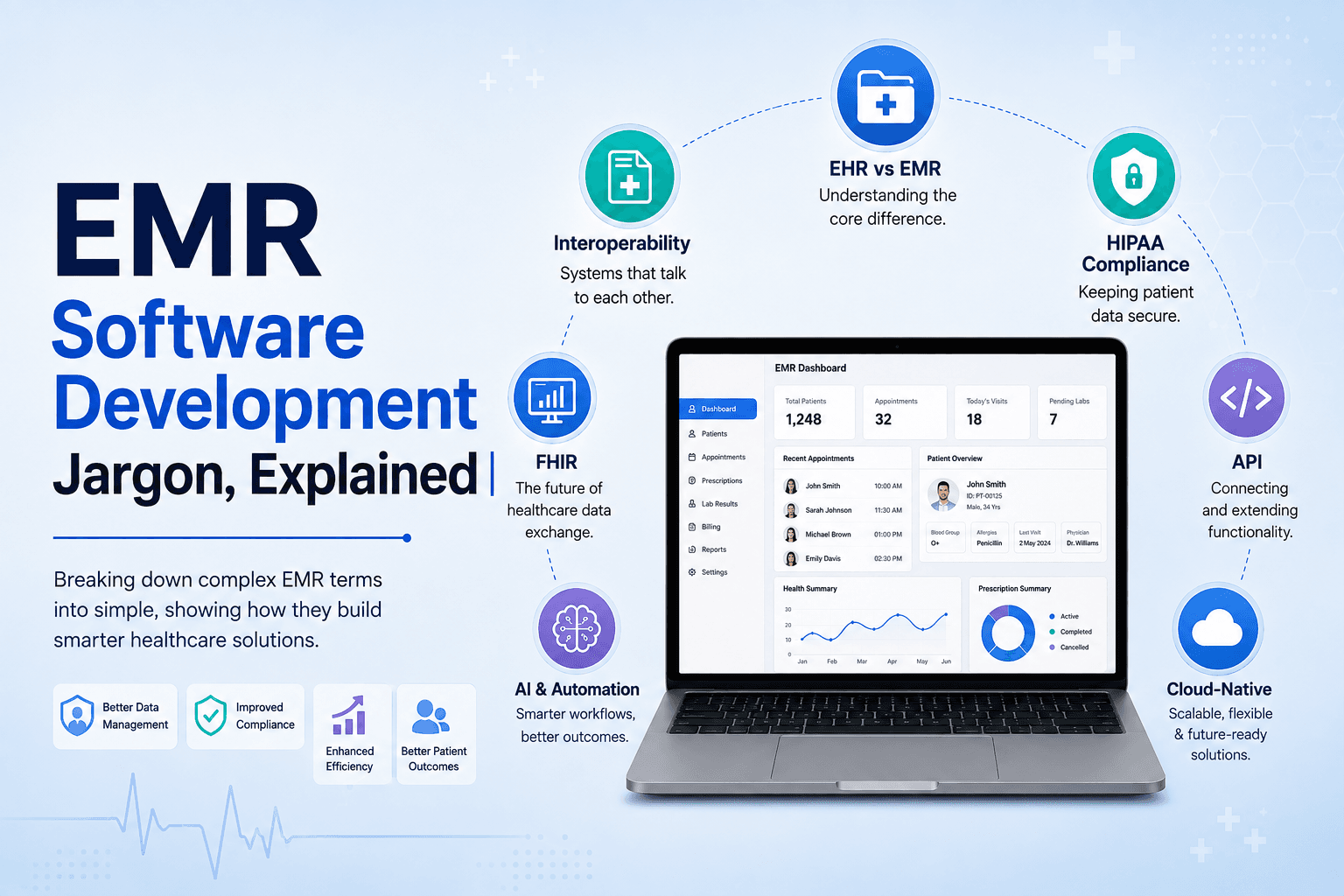
Vendor conversations about EMR software development tend to move fast through terms that sound similar but mean different things. Nodding along in a meeting isn't the same as actually knowing what you're agreeing to. This glossary breaks down the terms that come up most, in plain language, without the marketing gloss.
The Basics: EMR vs EHR
EMR (Electronic Medical Record)
The digital version of a patient's chart within one practice. Think of it as the practice's own filing cabinet, digitized. Custom EMR software is built around how that specific practice documents, orders, and bills.
EHR (Electronic Health Record)
Built to do everything an EMR does, plus share data across providers and care settings. If a patient sees a specialist and that specialist can pull up relevant history from their primary care visit, that's the EHR layer doing its job. Custom EHR software development usually involves more interoperability work than a standalone EMR.
Why the distinction matters
Vendors sometimes use these terms interchangeably, which isn't necessarily dishonest, but it can hide whether a system is actually built to exchange data externally or just labeled as if it is.
The Interoperability Terms
HL7 (Health Level Seven)
A set of standards for exchanging healthcare data between systems. When someone says a system "supports HL7," ask which version, since v2 and v3 work differently and aren't interchangeable.
HL7 v2
The older, message-based standard. Still widely used, especially for lab and pharmacy data exchange, because it's been the industry default for decades.
HL7 v3
A more structured, document-based approach that never achieved the same broad adoption as v2, but still appears in some healthcare data exchange contexts.
FHIR (Fast Healthcare Interoperability Resources)
The modern, API-first standard most new EMR and EHR software development projects are built around. If a vendor talks about "modern integration" without mentioning FHIR specifically, that's worth a direct follow-up question.
FHIR R4
The current widely adopted version of the FHIR standard. When evaluating custom EMR software, this is usually the version worth asking about by name.
SMART on FHIR
A framework that lets outside apps plug into an EHR securely, using FHIR as the connection layer. This is what allows a health system to add specialized tools without rebuilding core EHR functionality from scratch.
Interoperability
The general term for how well systems exchange data with each other. A vague claim of "interoperability" means little without specifics on which standards, which systems, and which data types are actually covered.
The Compliance Terms
HIPAA (Health Insurance Portability and Accountability Act)
The federal law governing how patient health information must be protected. Any EMR or EHR system touching patient data needs to meet HIPAA requirements around encryption, access control, and audit trails.
BAA (Business Associate Agreement)
A signed agreement required with any vendor that handles patient data on a practice's behalf. If a vendor building custom EMR software won't sign one, that's a serious red flag, not a minor administrative gap.
SOC 2
A compliance framework focused on how a vendor handles data security, availability, and confidentiality. Relevant mainly when data is being processed or stored by a third party as part of the system.
Audit Trail
A record of who accessed or changed patient data, and when. Required under HIPAA, and genuinely useful for catching errors or unauthorized access after the fact.
Role-Based Access Control
Limiting what each user can see or do in the system based on their role, so a billing staffer and a physician don't have identical access to the same data.
The Project and Build Terms
Discovery Phase
The initial stage of an EMR software development project focused on understanding actual workflows and integration needs before any development starts. Skipping or rushing this stage is one of the most common reasons custom builds miss the mark.
MVP (Minimum Viable Product)
A scaled-down version of a system built to test one core workflow before committing to a full build. For custom EMR software, this often means validating one specialty's charting workflow before expanding to the full system.
Data Migration
Moving existing patient records from an old system into a new one. Usually more time-consuming than technically difficult, since old data is rarely as clean as people assume.
Clinical Decision Support (CDS)
Features that surface relevant information or alerts to clinicians during a visit, like flagging a potential drug interaction. Increasingly built using AI and automation rather than static rule-based alerts alone.
Ambient Documentation
AI-assisted note-taking that drafts clinical documentation from a visit conversation, reducing manual charting time. One of the more practically useful applications of AI in EMR and EHR software development right now, as opposed to more speculative AI claims.
UI/UX (User Interface / User Experience)
How a system looks and how it actually feels to use day to day. In EMR software, UI/UX design has a direct effect on whether clinicians adopt the system or quietly build workarounds around it.
Terms Worth Being Skeptical Of
Some phrases show up constantly in vendor pitches without much specific meaning behind them:
"AI-powered" without naming what the AI actually does or what data it was built on
"Fully interoperable" without specifying which standard, which systems, or which data types
"HIPAA compliant" stated without willingness to explain encryption, access control, or audit trail specifics
"Custom" applied to a system that's actually a configured version of a generic template
None of these phrases are automatically dishonest, but a vendor who can't get specific when asked is telling you something.
Quick Answers
EMR covers records within one practice; EHR is built to share records across providers.
HL7 and FHIR are the standards that let EMR and EHR software exchange data with other systems, with FHIR being the modern, API-first approach.
A BAA is a required signed agreement with any vendor handling patient data, not optional paperwork.
An MVP approach lets a practice test one workflow before committing to a full custom EMR software development project.
Vague terms like "AI-powered" or "fully interoperable" are worth pushing vendors to define specifically.
Common Questions
Next Step
A discovery conversation through the Woltrio homepage is a good place to get plain answers to any of these terms as they apply to a specific project.