

























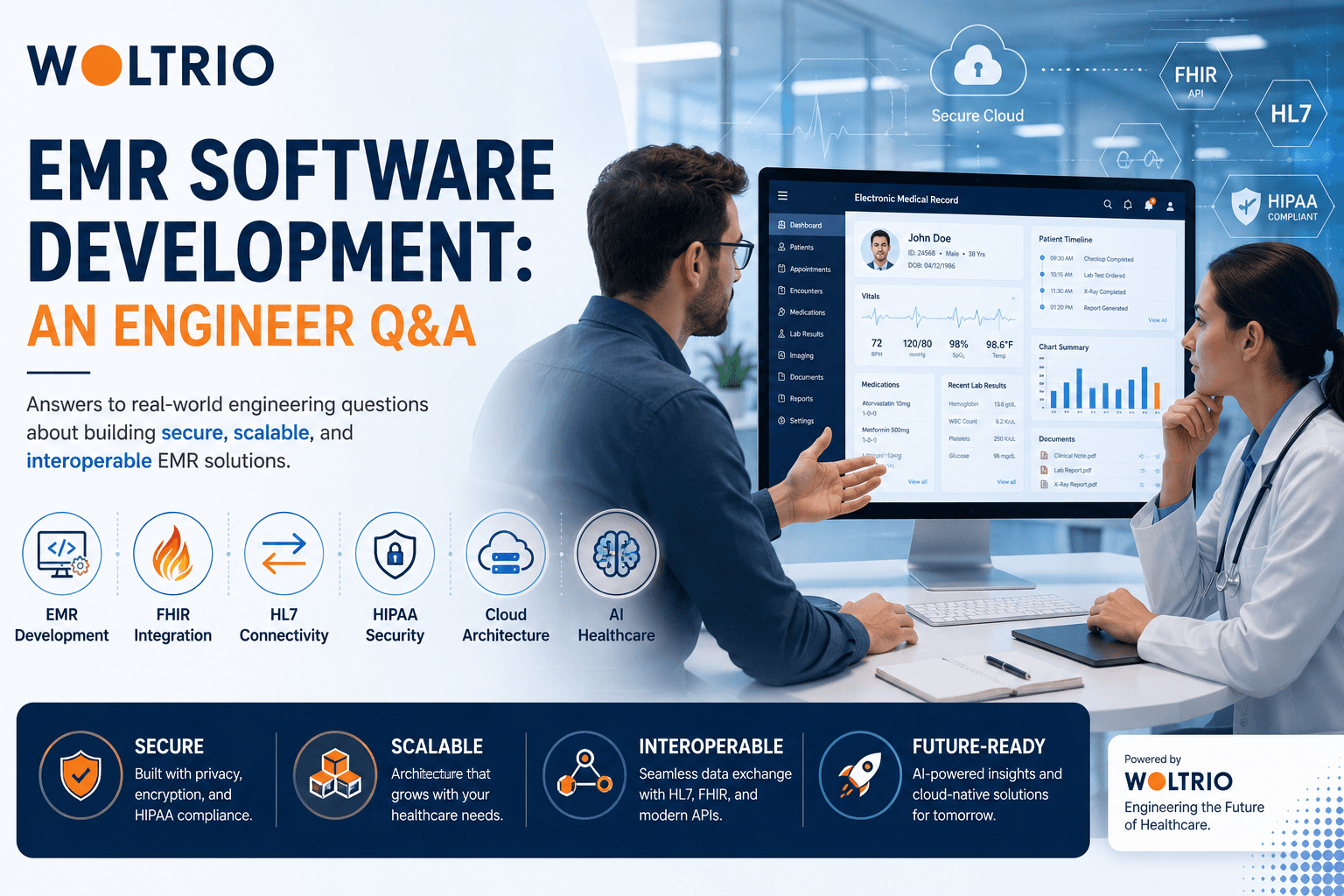
We sat down with one of Woltrio's engineers who works on EMR and EHR software development projects to answer the questions clients ask most often, before they sign, and the ones they wish they'd asked sooner.
Let's start basic. When a client says they need "custom EMR software," what are they usually actually asking for?
Honestly, it varies more than people expect. Sometimes it's a genuine gap, their specialty isn't well served by any off the shelf EMR. Other times what they really need is one specific workflow fixed, like order entry or a reporting problem, and "we need custom EMR software" is the biggest hammer they know to reach for. Part of our job in discovery is figuring out which one it actually is before we scope anything.
Is there a real difference between EMR software development and EHR software development, or is that just marketing language at this point?
There's still a meaningful difference. EMR traditionally means the record lives inside one practice, it's your chart, your system. EHR is built to move, sharing data across providers, referrals, other health systems. A lot of what we build blends both, because practices want their own clean workflow and the ability to exchange data externally. But if a vendor uses the terms completely interchangeably without knowing why, that's worth noticing.
What's the biggest misconception clients have going into a custom EMR project?
That the hard part is the interface. It's not. The interface is the part clients see and judge first, so it feels like the whole project, but the actual hard part is interoperability, getting the EMR to talk cleanly to labs, billing, other providers' systems through HL7 or FHIR. A beautiful interface sitting on top of messy data integration is still a broken system, it just looks nice while it's broken.
How long does a typical EMR software development project actually take?
Depends heavily on integration scope more than feature count. A single-specialty EMR with minimal outside integration can be four to five months. Add multi-department support, deep lab and billing integration, HL7 v2 and v3 plus FHIR, and you're looking at closer to nine months or more. Anyone quoting a firm timeline before understanding your integration needs is guessing.
What goes wrong most often in EMR builds that aren't done well?
Two things, mostly. First, compliance gets treated as a final checklist instead of something baked into architecture from day one, which means retrofitting encryption and access controls later, which is expensive and risky. Second, nobody talks to the actual clinicians who'll use it during design, so you get a system that's technically correct and practically painful to chart in.
How do you avoid that second problem?
We put clinical staff in front of prototypes early, not after development is mostly done. It slows down the first few weeks and saves months later. Our design work treats that clinician feedback loop as core to the process, not an optional nice-to-have.
Is HIPAA compliance genuinely difficult to get right in a custom build?
It's not conceptually difficult, encryption at rest and in transit, role-based access, audit trails, signed BAAs with vendors. It's difficult to retrofit if you didn't design for it from the start. We build HIPAA, SOC 2, and GDPR requirements, where relevant, into the architecture from day one specifically so it's not a scramble at the end.
What role does AI actually play in EMR software development right now, versus what's hype?
The realistic, useful stuff right now is documentation assistance, drafting notes from a visit conversation, and predictive flags built into the chart for at-risk patients. That's not hype, that's shipping in real systems today. What's overhyped is the idea of a general AI system that handles everything without being scoped to specific clinical questions. We build AI and automation around specific, well-defined use cases, not a vague "AI-powered EMR" claim.
If someone's unsure whether they need a full custom build, what do you tell them?
Start smaller than you think. MVP development on one workflow, like charting for a single specialty, tells you a lot before you commit to a nine-month build. It's also just a better way to catch design problems while they're cheap to fix.
Can a new custom EMR pull data from whatever system a practice is leaving?
In almost every case, yes. Data migration is a standard part of these projects. It's usually more time-consuming than technically hard, old data is rarely as clean as people remember it being.
Last question. What should someone evaluating EMR software development vendors ask that they usually don't think to ask?
Ask specifically how the vendor handles HL7 or FHIR integration, not just whether they "support interoperability," that phrase means almost nothing on its own. And ask who's actually going to be testing the system with real clinical scenarios before launch. If the answer is "our QA team following a script," that's different from clinicians walking through real patient scenarios. The second one catches problems the first one misses.
Quick Answers
EMR software development and EHR software development differ mainly in scope: EMR stays within one practice, EHR is built to share data externally.
The hardest part of a custom EMR build is usually interoperability and data integration, not the visible interface.
Timeline depends heavily on integration complexity, ranging from about four months for a focused single-specialty build to nine months or more for multi-department systems.
HIPAA compliance should be designed into the architecture from day one, not retrofitted after development.
Clinician involvement during design, not just after launch, is one of the biggest predictors of whether a custom EMR actually gets used well.
Common Questions
Is custom EMR software always better than an off the shelf system?
Not always. It makes the most sense when a specialty, workflow, or integration need isn't well served by existing platforms.
How much clinician time does a custom EMR project require?
More upfront during design than most practices expect, but that investment tends to reduce painful revisions later.
What's the first real deliverable in an EMR software development project?
Usually a scoped discovery document identifying the specific workflows and integrations the system needs to support.
Next Step
A discovery conversation through the Woltrio homepage is where most custom EMR projects start, before any development work begins.