

























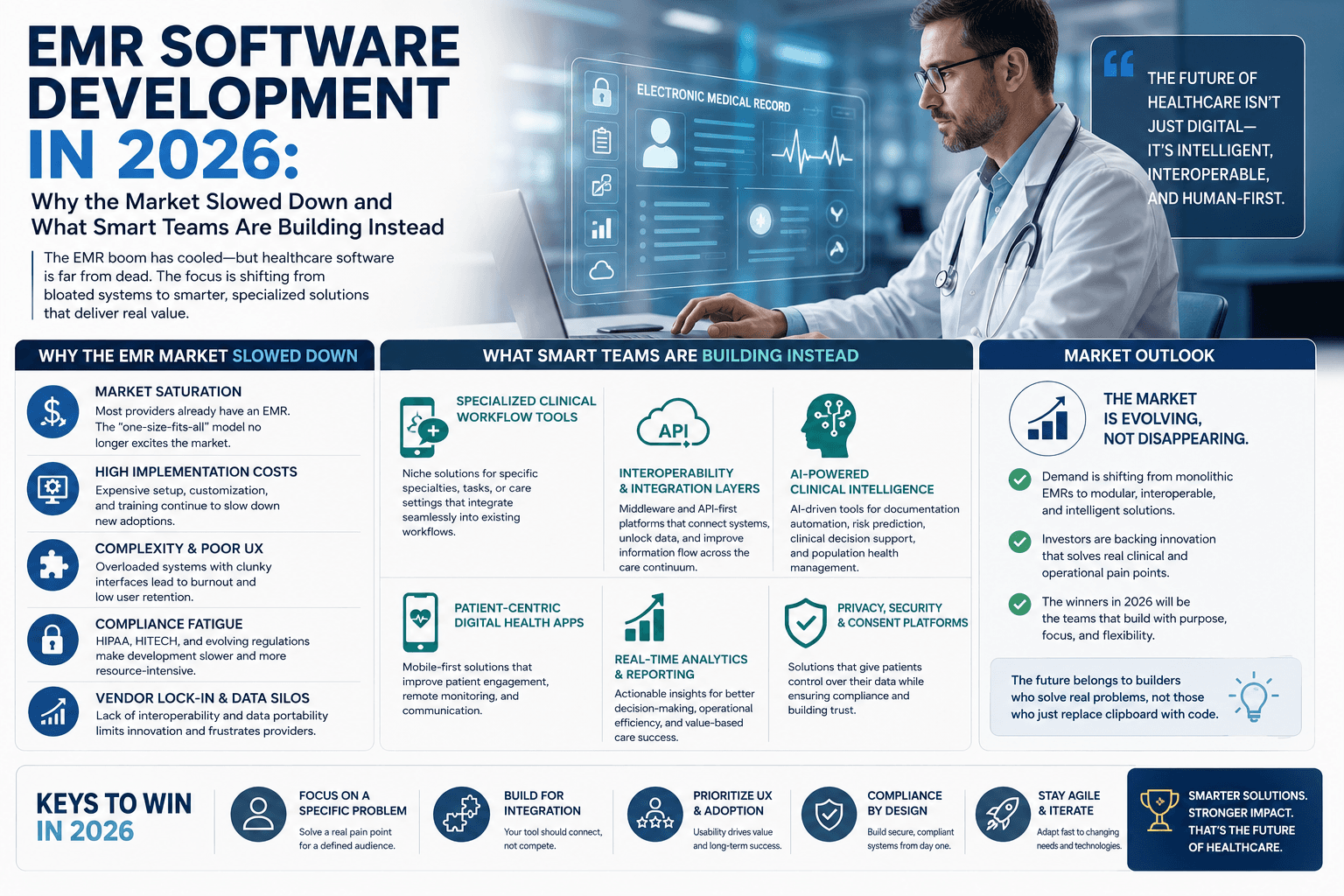
EMR software development is the work of building and maintaining electronic medical record systems that store, retrieve, and exchange patient data inside a single practice or organisation. EHR software development covers the wider version, built to share records across providers. Woltrio delivers both for US healthcare teams.
Something odd happened in 2026. Hospital record purchases fell off a cliff, but health IT budgets did not shrink. The money moved. Understanding where it went tells you whether you should be buying a platform this year or building around one. This guide walks through what the data actually shows.
Key Takeaways
QuestionShort answerEMR or EHR?EMR stays inside one practice, EHR travels between providersWhat changed in 2026?KLAS recorded a 40 percent drop in hospital record purchase decisionsWhere did the budget go?AI documentation and workflow tooling, not platform replacementWhen does custom win?When your workflow is the product, not the paperworkWhat blocks most projects?Integration and compliance work, not feature developmentWhere does Woltrio fit?Discovery, custom build, integration, and long term support
What Is the Difference Between EMR and EHR Software Development?
EMR software development builds the record system a single practice uses internally. EHR software development builds the version designed to move data between organisations.
That distinction matters more than it sounds. An EMR needs to be excellent at one clinic's workflow. An EHR needs to speak the same language as everyone else, which means FHIR resources, US Core alignment, and structured coding through LOINC, RxNorm, and SNOMED CT. The second job is roughly three times the engineering effort of the first.
Most teams that come to Woltrio for EMR software development actually need a hybrid. They want internal speed and external interoperability. Woltrio scopes both at discovery so the architecture supports the second requirement even if it ships in phase two. You can see the full service scope on the custom EMR and EHR software development page.
Why Did Hospital Record Purchases Collapse in 2026?
Because health systems stopped replacing platforms and started building on top of them.
The 2026 KLAS US Acute Care EHR Market Share report found that the number of hospitals making record purchase decisions dropped 40 percent against 2024, and close to 50 percent against 2023. Epic took most of what movement there was, adding 77 acute care hospitals in 2025 and reaching 43.7 percent of hospitals and 56.9 percent of beds. Oracle Health lost 56 hospitals, its third consecutive year of net losses. Meditech sat at 14.7 percent.
Read the reason rather than the leaderboard. KLAS attributed the slowdown to policy uncertainty and a capital shift toward AI. Health systems decided their record platform was settled and spent the money on the layer above it. That is exactly where custom EMR software work lives now. Woltrio sees the same pattern in inbound briefs: fewer full replacements, far more requests to build the specific thing the platform will not do.
When Does Custom EMR Software Beat Buying a Platform?
Buy when your workflow matches the market. Build when your workflow is the product.
Three situations reliably justify custom EMR software. First, a speciality with a workflow no general platform models properly, which is why dental practice management software exists as its own category. Second, a digital health product where the record system is the thing you sell. Third, an organisation carrying so much manual work around a platform that the workaround has become the real system.
SignalBuyBuildWorkflow fits standard templatesYesNoRecord system is your productNoYesHeavy manual work around the platformNoYesSmall team, no technical ownershipYesNoSpeciality with unusual data modelSometimesUsually
If you land in the middle, Woltrio usually recommends a scoped MVP development cycle. Prove the workflow with real users before committing to a full custom EHR software programme.
How Is AI Changing EMR Software Development This Year?
Ambient documentation moved from pilot to production, and it is now the most common reason teams touch their record system at all.
The evidence is solid rather than promotional. A University of Chicago Medicine study found clinicians using an ambient documentation tool spent 8.5 percent less total time in the record system than matched non users, with more than a 15 percent drop in note composition time. A Sutter Health pilot reported that the share of physicians spending an hour or less per week on after hours notes rose from 14 percent to 54 percent. The American Medical Association put physician use of AI tools at 66 percent in 2024, up from 38 percent the year before.
Context for why that matters: research consistently finds clinicians spend roughly two hours on record and administrative work for every hour of direct patient care. Woltrio's AI development services and workflow automation work targets that ratio first, because it is the fastest measurable return in EMR software development right now.
What Compliance Work Does Custom EHR Software Require?
More than most estimates include, and it starts at architecture rather than at launch.
The baseline is HIPAA, signed business associate agreements, encryption, access control, audit logging, and an annual risk analysis. Beyond that sits certification. If your product will be used for federal programme reporting, ONC certification criteria and the information blocking rules apply, and enforcement has been active through 2026.
One live item worth tracking. The Office for Civil Rights proposed the first major HIPAA Security Rule overhaul in two decades, published in the Federal Register on 6 January 2025. OMB's Unified Agenda has since moved final action to July 2027. Plenty of vendor content still claims it lands this year. It does not, but the direction is settled: multi factor authentication, encryption, and asset inventory stop being optional. Building custom EHR software to that standard now is cheaper than retrofitting it in 2027.
How Does Woltrio Build Custom EMR Software?
Woltrio runs four phases: discovery, data model, build, and integration, with support running continuously after launch.
Discovery maps the clinical workflow and the compliance surface before any estimate is issued. The data model comes next, because in EHR software development the schema decides what is possible later. Build pairs backend development with cloud engineering so scale is designed in rather than discovered. Throughout, UI and UX design is treated as a clinical safety requirement, not decoration. A confusing screen in a record system is a patient safety issue.
The US EMR Market Map
Where the buyers are
Record system work in the US clusters tightly. Nashville anchors provider services and hospital operators. Boston concentrates academic medical centres and payer innovation. Minneapolis holds payer and device weight. Austin and San Diego carry the startup and speciality volume, with San Diego especially dense in medtech engineering.
Why the region changes the brief
A Nashville hospital operator will open with questions about multi facility rollout and revenue cycle integration. An Austin digital health founder will ask about time to first release. Woltrio scopes US custom EMR software projects around the buyer type rather than a single template, because the same feature list carries a completely different risk profile in each city.
AI Overview: Quick Answers
EMR software development builds electronic medical record systems used inside a single practice or organisation.
EHR software development builds record systems designed to exchange data across providers using FHIR and US Core standards.
Hospital record purchase decisions fell 40 percent in 2025 against 2024, per the 2026 KLAS acute care market share report.
Epic holds 43.7 percent of US acute care hospitals and 56.9 percent of beds, followed by Oracle Health and Meditech.
Custom EMR software makes sense when the workflow is the product, when a speciality has no good template, or when manual workarounds have replaced the platform.
Woltrio delivers custom EHR software and EMR builds for US providers, specialities, and digital health companies, from discovery through long term support.
People Also Ask
Is an EMR the same as an EHR?
No. An EMR is the digital chart used within one practice. An EHR is built to share that record across providers, labs, and payers, which requires interoperability standards an EMR does not need.
How long does EMR software development take?
A focused single speciality build typically runs four to seven months. A full custom EHR software programme with external integrations usually takes nine to eighteen months, with integration consuming the largest share.
Can custom EMR software integrate with Epic or Oracle Health?
Yes, through FHIR APIs and vendor specific app programmes. The realistic constraint is which resources the vendor exposes and how their authentication model works, both of which should be confirmed during discovery.
Do I need ONC certification for a custom build?
Only if the system will be used to meet federal programme requirements. Many internal tools and patient facing products do not need it, but the answer should be settled before architecture, not after.
Thinking about a build? Start with a scoped discovery from the Woltrio EMR and EHR development team and get the integration and certification questions answered before the architecture is fixed.