

























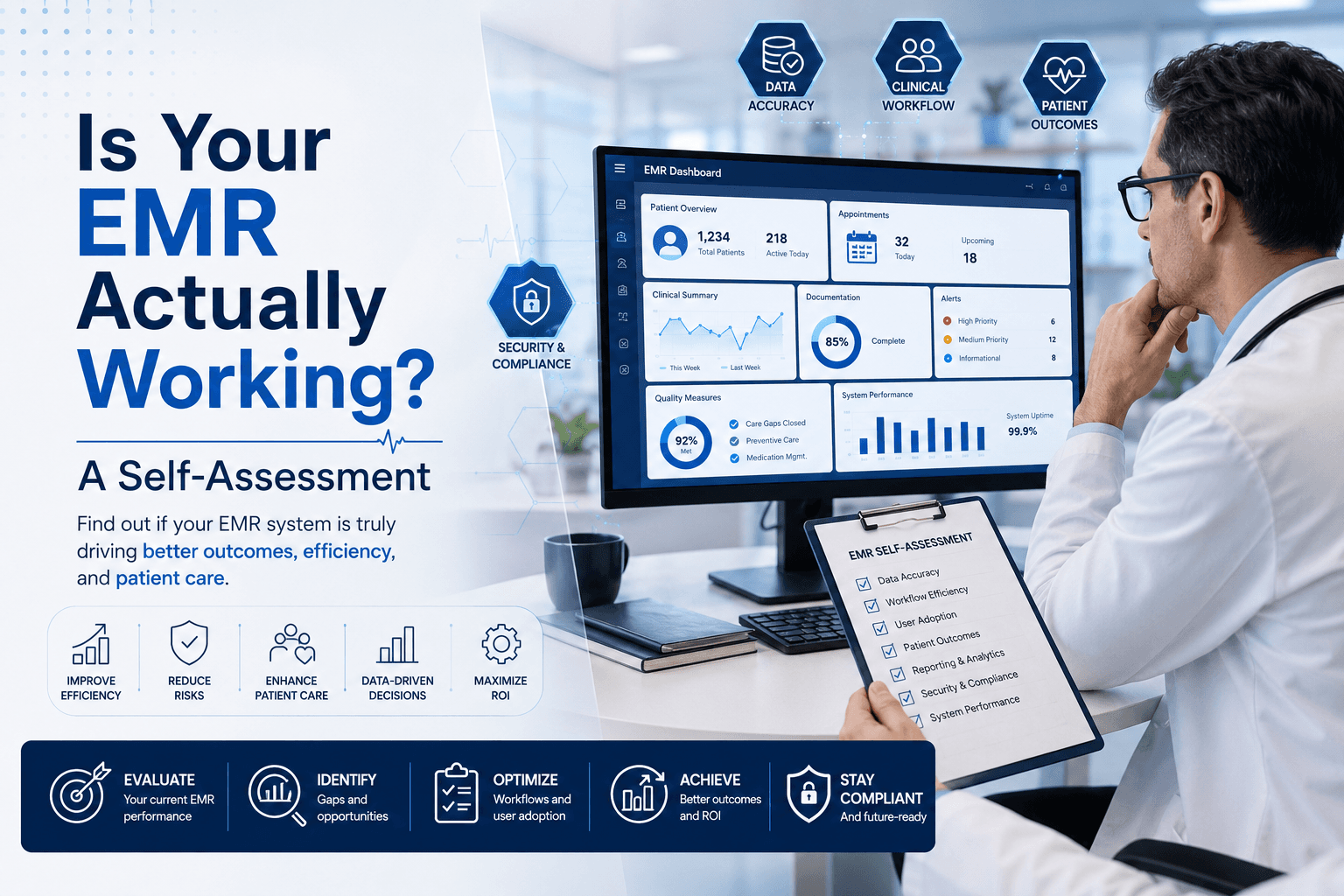
Most practices don't decide to replace their EMR because of one dramatic failure. They decide after months of small frustrations finally add up. This scorecard turns those vague frustrations into a number, so the decision is based on something more concrete than a bad week.
Score each category from 0 to 3, then add them up at the end.
1. Charting Speed and Fit
0 — Clinicians regularly complain the EMR doesn't match how they actually document, and workarounds are common.
1 — Charting works but requires extra clicks or steps that feel unnecessary for routine visits.
2 — Charting is mostly smooth, with occasional friction for less common visit types.
3 — Charting matches clinical workflow closely, with minimal extra effort beyond the documentation itself.
2. Interoperability (Labs, Imaging, Referrals)
0 — Data from labs or imaging has to be entered manually, or referral information gets lost between systems.
1 — Some integrations exist but are unreliable or require manual double-checking.
2 — Most integrations work well, with occasional manual intervention needed.
3 — Lab, imaging, and referral data flow in automatically through HL7 or FHIR with no manual re-entry.
3. Billing and Claims Accuracy
0 — Claims frequently get rejected due to documentation and billing mismatches, creating rework for staff.
1 — Rejections happen occasionally and require manual correction.
2 — Claims mostly go through cleanly, with rare exceptions.
3 — Billing pulls directly from clinical documentation with minimal manual claims correction needed.
4. Compliance Confidence
0 — Nobody on staff can confidently explain how the system handles HIPAA requirements like encryption, access control, or audit trails.
1 — General compliance is assumed but hasn't been reviewed or confirmed recently.
2 — Compliance has been reviewed, with minor open questions.
3 — HIPAA, and SOC 2 or GDPR where relevant, are clearly documented and confidently understood by staff.
5. Reporting and Visibility
0 — Getting basic reports, like production by provider, requires manual spreadsheet work.
1 — Reports exist but take real effort to pull together accurately.
2 — Most reporting is available on demand, with occasional manual work for specific requests.
3 — Leadership can pull relevant reports on demand without manual effort.
6. Staff Sentiment
0 — Staff routinely mention wanting to switch systems or maintain workarounds like spreadsheets outside the EMR.
1 — Staff tolerate the system but mention specific recurring frustrations.
2 — Staff are generally satisfied, with occasional minor complaints.
3 — Staff rarely mention friction with the system in day-to-day use.
Scoring Your Total
0-6: Likely time for a real conversation about replacement. Multiple core areas are creating daily friction. A full custom EMR software development project, scoped through discovery, is probably the right next step rather than patching individual issues.
7-12: Targeted fixes or a phased upgrade make sense. The system's foundation may be workable, but specific weak areas, often interoperability or reporting, are worth addressing directly. This is a good scenario for MVP development focused on the lowest-scoring category rather than a full rebuild.
13-16: The system is functional with room to improve. Look at the lowest individual score and address it specifically rather than treating the whole system as broken.
17-18: The current EMR is genuinely working well. Revisit this scorecard periodically, since needs change as a practice grows, but there's no urgent case for a switch right now.
Why This Scorecard Focuses on These Six Areas
These categories aren't arbitrary. Charting fit and interoperability tend to drive daily staff frustration, billing accuracy and compliance confidence carry real financial and legal risk, and reporting visibility and staff sentiment are usually the clearest early warning signs before a bigger problem shows up. Custom EMR and EHR software development projects tend to succeed when they address whichever of these six is genuinely weakest, rather than rebuilding everything at once because one area is frustrating.
What Low Scores Actually Mean in Practice
A low interoperability score usually means data isn't flowing cleanly between the EMR and outside systems, which Woltrio typically addresses through HL7 v2/v3 or FHIR integration work rather than replacing the whole platform. A low compliance score is worth treating as urgent regardless of the total, since HIPAA gaps carry risk independent of how satisfied staff feel day to day. A low reporting score often points to a data structure problem underneath, not just a missing dashboard, which is where AI and automation can help by automating the reporting layer once the underlying data is clean.
If the Score Points Toward a Custom Build
A typical custom EMR software development project moves through discovery to confirm which categories actually need rebuilding, architecture planning around necessary integrations, design informed directly by clinical staff, development and testing against real scenarios, and a launch phase with training included. Projects scoped around one or two weak categories, rather than a full rebuild, often move faster and cost less than practices initially expect.
Quick Answers
A low interoperability score usually points to a specific HL7 or FHIR integration gap, not a reason to replace the entire EMR.
A low compliance score should be treated as urgent regardless of the total score, since HIPAA gaps carry independent risk.
A total score under 7 suggests a full custom EMR software development conversation is worth having.
A total score of 13 or higher usually means targeted fixes to the lowest category are more appropriate than a full rebuild.
Common Questions
Should I retake this scorecard periodically?
Yes, needs shift as a practice grows, adds locations, or takes on new integration requirements, so revisiting it every six to twelve months is reasonable.
What if different staff members would score the system differently?
That's common and worth discussing directly. A wide gap between front desk and clinical scores often points to a workflow issue specific to one role.
Does a low score always mean a full custom rebuild is necessary?
No. Scores in the 7-12 range usually point to targeted fixes being the better first step, with a full rebuild only warranted for consistently low scores across most categories.
Next Step
A discovery conversation through the Woltrio homepage is a useful next step for turning a low score into a specific, scoped plan.