
























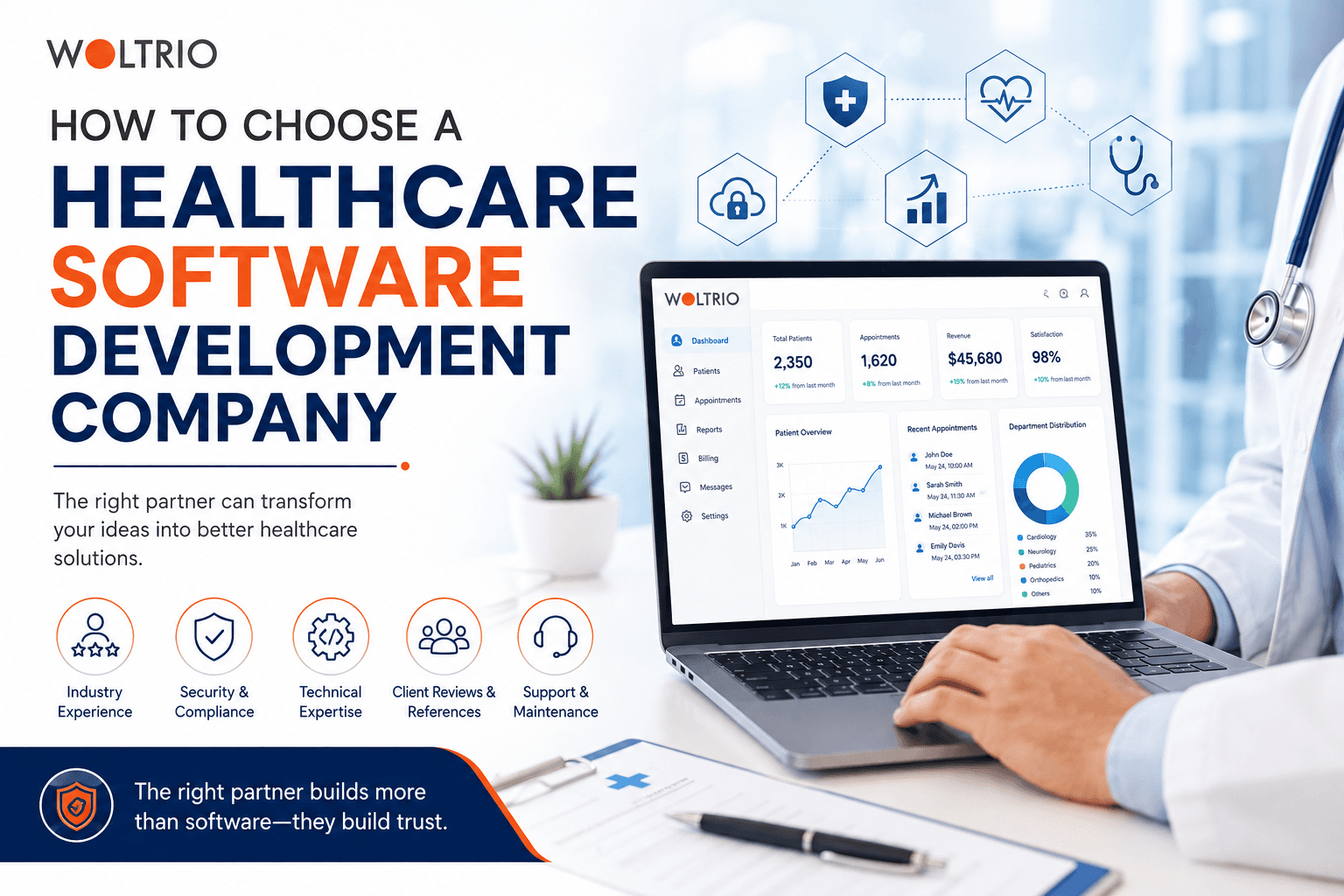
The best healthcare software development company is one that understands clinical workflows, follows strict data privacy rules, and has a track record of shipping systems that clinicians actually want to use. That's the short answer. But picking the right partner for a project that touches patient data, staff schedules, and daily operations takes more than a gut feeling.
If you're a hospital administrator, clinic owner, or health tech founder searching for a partner in 2026, you already know the stakes. A poorly built system can slow down your staff, expose patient data, or fail an audit. A well-built one can save hours every day and improve care.
This guide walks through what actually separates a good healthcare software partner from a risky one, what questions to ask before you sign anything, and what the entire process should look like from the first call to the months after launch.
Why Choose a Specialized Healthcare Software Company?
You should choose a specialized healthcare software company because generic developers often miss the regulatory, clinical, and workflow details that make or break a medical system. Building an app for a retail store is not the same as building one for a hospital floor.
A general software agency might be perfectly capable of writing clean code. But healthcare software has a few extra layers that most industries don't deal with:
Patient data privacy laws that carry real financial and legal penalties
Clinical workflows that vary by department, specialty, and even by shift
Interoperability standards like HL7 and FHIR that let systems talk to each other
Integration with existing electronic health records and lab systems
Long-term support needs, since healthcare software rarely gets replaced quickly
A team that has already solved these problems for other healthcare organizations will move faster and make fewer costly mistakes. Companies like Woltrio build specifically for this environment, which means the learning curve that would normally slow down a generic dev shop is already behind them.
Industry Experience
Industry experience matters because healthcare software has to work around real clinical routines, not just business logic. A developer who has never sat in on a nurse's shift or watched a billing team close out claims will design software that looks fine on paper but frustrates the people using it every day.
Ask any potential partner how many healthcare projects they've delivered and what those projects actually were. A company that has built custom EMR and EHR systems, patient portals, and specialty tools like dental practice management software understands the small details that generic developers overlook, like how a front desk actually schedules appointments or how a clinician wants to review lab results without extra clicks.
Here's a simple way to compare experience levels across vendors:
What to CheckGeneralist AgencySpecialized Healthcare PartnerUnderstands clinical workflowsRarelyUsually yesFamiliar with HL7/FHIR standardsSometimesAlmost alwaysHas built EMR/EHR systems beforeUncommonCommonKnows healthcare compliance requirementsLearns as they goAlready trainedSpeed to first working versionSlowerFaster
Real experience shows up in the questions a company asks you, not just the ones you ask them. If a vendor immediately asks about your patient volume, your existing systems, and your compliance requirements, that's usually a good sign.
HIPAA Compliance
HIPAA compliance means the software company builds encryption, access controls, and audit trails into the system from the very start, not as an afterthought. This one point alone can eliminate half the vendors on your shortlist.
Any company touching patient data in the United States needs to understand HIPAA inside and out. That includes:
Data encryption both when it's stored and when it's being sent
Role-based access so staff only see what they need to see
Detailed audit logs that track who accessed what and when
Secure hosting environments with proper safeguards
Business associate agreements signed before any work begins
Don't just take a company's word for it. Ask for documentation, ask how they've handled compliance on past projects, and ask what happens if there's a security incident. A partner with real healthcare depth will have clear, confident answers instead of vague reassurances.
It also helps if the company is transparent about its broader security posture, including things like SOC 2 or ISO certifications, since these often overlap with the same practices that keep patient data safe.
Questions to Ask Before Hiring
Before hiring, ask about the company's healthcare project history, their compliance process, their communication style during development, and what support looks like after launch. These questions reveal far more than a sales pitch ever will.
Here's a practical list to bring to your first conversation:
How many healthcare-specific projects have you completed, and can we speak with a past client?
What does your HIPAA compliance process actually look like, step by step?
Who will be on our project team, and will that team stay consistent through the whole build?
How do you handle integrations with our existing EHR or lab systems?
What happens if our requirements change halfway through the project?
How do you test for security vulnerabilities before launch?
What kind of support do you offer once the system goes live?
Pay attention to how a company answers, not just what they say. Clear, specific answers usually point to real experience. Vague or overly rehearsed answers are worth a second look.
It's also worth asking about the technology itself. A company that offers full-stack capability, from frontend interfaces to backend systems and cloud infrastructure, can usually manage a project end to end without bringing in multiple outside vendors. That reduces coordination headaches and keeps your project timeline more predictable.
Development Process
A healthcare software company's development process should include discovery, design, development, testing, and a clear plan for launch, with regular check-ins at every stage. If a vendor can't clearly describe this process, that's a warning sign.
A typical, well-run process looks like this:
Discovery and planning — understanding your workflows, goals, and existing systems
Strategy and architecture — planning the technical foundation, including security and compliance
Design and prototyping — creating wireframes and mockups that real clinicians and staff can react to
Development and integration — building the system in stages with ongoing testing
Launch and training — rolling out the system and training your staff to use it
Ask how the company handles each of these stages, and how often you'll see progress. Some companies build in weekly demos so you can catch issues early instead of finding out at the very end. Others include dedicated UI/UX work, since a system that looks clean and is designed around real clinical use tends to get adopted faster by staff.
For newer health tech products, ask whether the company offers an MVP development path. Starting with a smaller, functional version lets you test the concept with real users before investing in a full-scale build. This is especially useful for startups trying to validate an idea before committing a larger budget.
Post-Launch Support
Post-launch support means the software company continues fixing bugs, applying security updates, and helping your staff after the system goes live, not just disappearing once the invoice is paid. This is one of the most overlooked parts of choosing a partner.
Healthcare software isn't something you build once and forget. Regulations change, patient volumes grow, and new integrations come up over time. Before signing a contract, get clear answers on:
Response times for critical bugs versus minor issues
Whether ongoing maintenance is included or billed separately
How security patches and updates are handled going forward
Whether the same team that built the system will support it later
What training resources are available for new staff down the road
A company that treats support as an afterthought will often leave you scrambling when something breaks at the worst possible time, like during a busy clinic morning or right before an audit.
Some vendors also offer automation tools that reduce the support burden over time. For example, healthcare automation solutions can handle repetitive tasks like appointment reminders or claims routing, which means fewer manual fixes and fewer support tickets down the road.
What Makes a Great Long-Term Partner
Choosing a healthcare software company isn't just about the first project. It's about finding a partner who can grow with you. As your organization adds locations, expands services, or serves patients across different regions, your software needs to keep up.
Some healthcare organizations serve patients across borders or manage teams in multiple countries. In those cases, it helps to work with a company that has experience beyond one market, whether that's building mobile applications for international healthcare clients or applying AI-driven automation across different regulatory environments.
AI is also becoming a bigger part of healthcare software in 2026, from predictive analytics to clinical documentation support. A company that offers dedicated AI development services can help you plan for these features now, even if you're not ready to build them yet, so your system doesn't need a costly rebuild later.
Red Flags to Watch For
Not every vendor that says "we do healthcare" actually understands healthcare. Watch out for these warning signs during your search:
Vague answers about HIPAA or compliance processes
No examples of past healthcare projects, or examples they can't discuss in detail
Pressure to sign quickly without a proper discovery phase
No clear plan for post-launch support
Communication that feels rushed or scripted rather than genuine
Trust your instincts here. If something feels off during the sales process, it usually gets worse once the contract is signed.
Final Thoughts
Choosing the right healthcare software development company comes down to three things: real industry experience, a genuine commitment to compliance, and a clear process from planning through post-launch support. Take your time during the vetting process, ask direct questions, and don't be afraid to walk away from a vendor that can't answer them clearly.
The right partner won't just build software. They'll understand your patients, your staff, and the daily reality of running a healthcare organization, which is exactly what separates a system people actually use from one that sits unused after launch.
Frequently Asked Questions
How long does it take to build custom healthcare software?
Timelines vary widely depending on scope, but a basic MVP can often be ready in a few months, while a full enterprise system may take six months to a year or more.
Do I need a HIPAA-compliant developer even for a small clinic?
Yes. HIPAA applies regardless of practice size, so any system touching patient data needs to meet the same core privacy and security standards.
Can healthcare software integrate with the systems I already use?
In most cases, yes. Standards like HL7 and FHIR exist specifically to help new software communicate with existing EHRs, labs, and billing systems.
What's the difference between hiring a generalist developer and a healthcare-focused one?
A generalist can write functional code, but a healthcare-focused company already understands clinical workflows, compliance requirements, and the small usability details that affect daily adoption by staff.
Is it worth building an MVP before a full healthcare platform?
For most startups and new health tech products, yes. An MVP lets you test the core idea with real users before committing a larger budget to a full build.