



















Gartner looked at the thousands of companies advertising agentic AI capability and found roughly 130 that genuinely qualified. Everyone else was selling chatbots, robotic process automation, and assistants with new vocabulary bolted on. The industry now has a term for this. Agent washing.
That is the honest starting point for anyone shopping for AI chatbot development in 2026. The category is loud, the labels have drifted, and most of the claims made in sales conversations do not survive twenty minutes of checking.
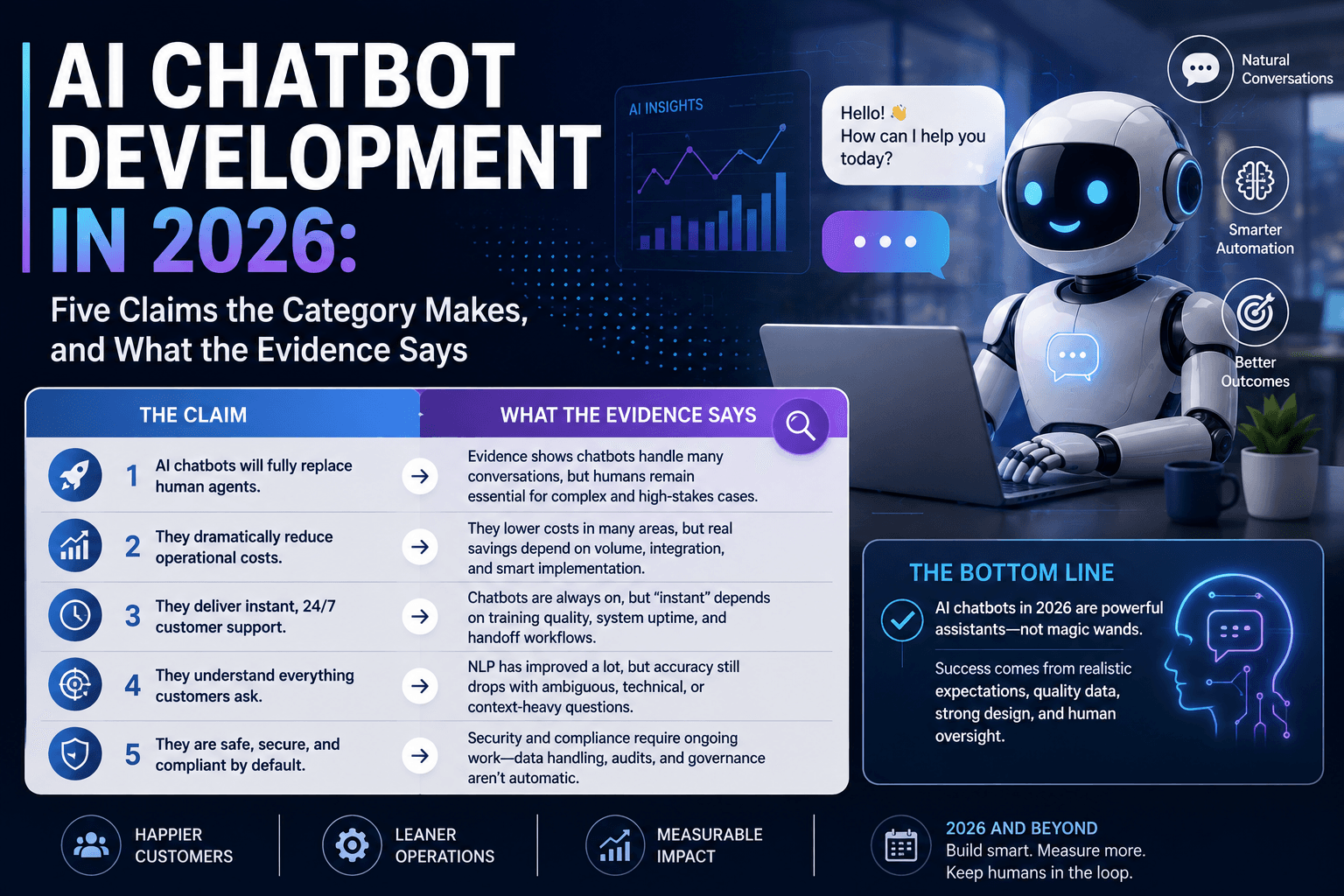
Below are five claims you will hear, tested against what the evidence actually shows. Some hold up. Some do not. The ones that do not are usually the reason a project gets cancelled eighteen months in.
Claim 1. Agentic AI has replaced chatbots
What the evidence says. Mostly no, and the gap between intent and reality is enormous. Forrester found around 75 percent of enterprise leaders describing themselves as adopting agentic AI in June 2026. Gartner's 2026 CIO Survey found 17 percent had actually deployed agents. Deloitte put production ready systems at 11 percent.
What it means for your build. The thing being marketed to you as an agent is, in most cases, a chatbot with tool access. That is not an insult. A well built retrieval chatbot with two or three system integrations solves a large share of real business problems and carries a fraction of the governance burden. Ask a vendor which of the two you are buying. If the answer is vague, you are buying the chatbot at agent prices.
Claim 2. The 40 percent cancellation statistic proves AI does not work
What the evidence says. The number is real and consistently misdated. Gartner published it on 25 June 2025, predicting that more than 40 percent of agentic AI projects would be cancelled by the end of 2027, citing escalating costs, unclear business value, and inadequate risk controls. A wave of 2026 coverage dropped the original date and presented a 2025 forecast as a fresh 2026 finding.
Read the reasons rather than the headline. Gartner's own framing, and subsequent analysis, both land in the same place. Projects rarely die because the model could not do the work. They die from cost escalation, undefined value, and missing risk controls. Those are management failures, not model failures.
What it means for your build. Every one of those three causes is decided before any code is written. Scope, a measurable outcome, and a named owner for what happens when the bot is wrong are the actual deliverables of a good discovery. Woltrio treats them as the first phase of any AI development engagement for exactly this reason.
Claim 3. You need a custom build
What the evidence says. Often you do not, and any AI chatbot development company willing to say so is worth more than one that is not.
If your use case is answering questions from documents you already have, in one language, with no writes to any system of record, the off the shelf tooling is genuinely good now and custom development is hard to justify. The economics changed. Building a competent question answering bot is no longer the hard part.
Custom development earns its cost in four situations. When the bot has to write to a system of record rather than just read. When you operate under regulation that makes being wrong expensive. When the data lives across systems that no vendor connector reaches. And when the conversation is the product rather than a support layer on top of it.
What it means for your build. Ask which of those four applies to you. If none do, buy the platform. Woltrio's honest answer in that scenario is that a scoped MVP will tell you within weeks, and that is cheaper than finding out through a full build.
Claim 4. The model is the hard part
What the evidence says. Integration is the hard part, and it always has been. Gartner's guidance on agentic projects specifically flags that connecting to legacy systems is technically complex, frequently disrupts existing workflows, and requires costly modifications.
This matches what actually happens in delivery. The conversational layer is weeks. The authentication model, the permissions logic, the audit trail, the failure handling when an upstream system is down, and the question of what the bot is allowed to do on a user's behalf are where the months go.
What it means for your build. Judge chatbot development solutions on integration depth, not on demo quality. A demo tests the model. Production tests everything else. Woltrio's chatbot work leans on backend development and cloud engineering for precisely this reason, because that is where the risk concentrates.
Claim 5. Governance can come later
What the evidence says. This is the claim with the shortest shelf life. A separate Gartner forecast published on 26 May 2026 expects 40 percent of enterprises to demote or decommission autonomous agents by 2027 after governance failures surface in production. Not at pilot. In production, where the cost of unwinding is highest.
The pattern is consistent. Pilots succeed because the stakes are low and a human is watching. Production fails because nobody defined who is accountable, what the bot may do unsupervised, and how a bad output gets caught.
What it means for your build. Four things belong in scope from day one. Graduated autonomy rather than full autonomy at launch. Human verification gates matched to how costly an error would be. A named owner per bot. And logging good enough to reconstruct any conversation after the fact.
In regulated settings this stops being optional. A bot touching protected health information inherits every HIPAA obligation the underlying system carries, which is why Woltrio scopes chatbot work in healthcare alongside custom EMR and EHR development rather than as a separate, lighter category of project.
What to actually scope
Strip the category language away and a workable AI chatbot development brief answers six questions.
What decision or task does this change, and how will you measure it in ninety days?
Does the bot read only, or does it write to a system of record?
Which systems must it reach, and does an API exist for each one?
What happens when it is wrong, and who finds out?
What may it do without a human in the loop, at launch and later?
Who owns it in twelve months?
A vendor who wants to talk about models before answering these is selling you the demo. Woltrio's workflow automation and chatbot engagements start with those six, because the answers determine whether the project belongs in the 40 percent or outside it.
The best outcome of a first conversation with an AI chatbot development company is sometimes a smaller project than you arrived expecting. That is not a lost sale. That is the difference between shipping and cancelling.
Start with a scoped discovery from Woltrio.