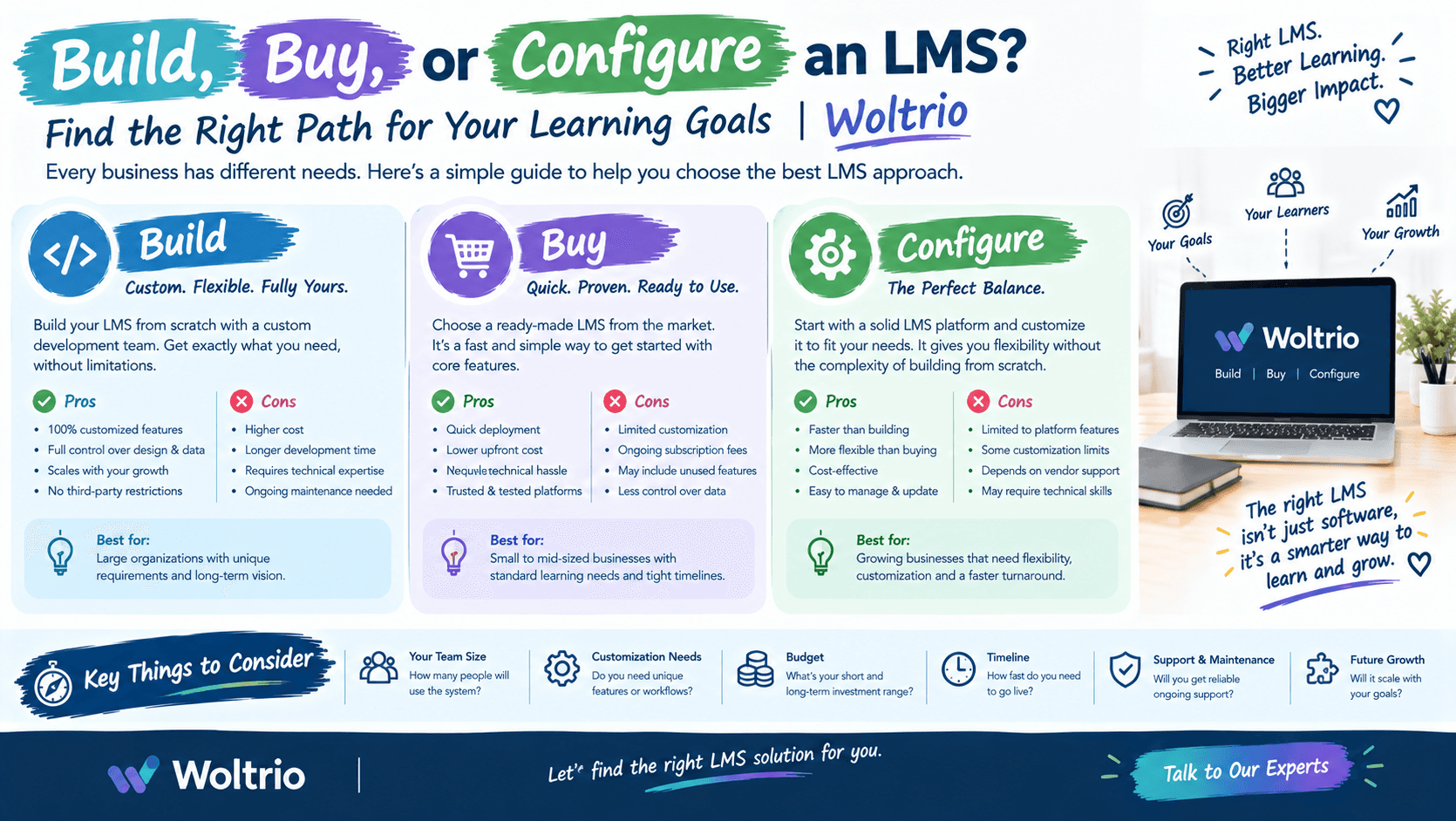
Most organizations frame the LMS question as custom versus off the shelf. That framing hides a third option, and it hides the fact that the right answer can differ by layer of the system. This guide breaks the decision into three paths and gives you a way to choose.
The Three Paths
Buy means adopting an existing platform as it comes, with its standard workflows and reports.
Configure means adopting an existing platform and bending it with settings, plugins, and light integration work.
Build means custom LMS development, where the workflow, integration, and reporting logic are designed around your organization.
None of these is the grown-up choice. Each one fits a different situation.
Side by Side
BuyConfigureBuildBest forStandard training needsMostly standard needs with a few gapsSpecific workflows, integrations, or audit formatsSetup speedFastestModerateSlowest at the startHR and login integrationWhatever the vendor supportsPlugins and connectors, with limitsDesigned to your systemsCertification cyclesGeneric rulesPartly adjustableModeled on your real cyclesCompliance reportingStandard exportsAdjusted exportsFormatted to your auditorsOngoing workaround costOften high if needs are specificModerateLower once built
When Buying Is the Right Call
Buying works well when your training is straightforward. General onboarding, a handful of compliance modules, and simple completion tracking are handled well by mature platforms. If your needs fit the standard shape, a custom build adds cost without adding value. Saying so plainly is part of being a trustworthy LMS development company.
When Configuring Is the Right Call
Configuring fits organizations whose needs are mostly standard but include one or two specific gaps. Maybe the platform handles everything except syncing with your HR system, or reporting is fine except for one audit format. A targeted integration or plugin can close a narrow gap without a full rebuild.
The warning sign here is stacking workarounds. When you are configuring around the same limitation for the third time, you are probably paying build prices for a configured result.
When Building Is the Right Call
Building pays off when the gaps sit in the core of how your organization operates. Four situations come up most often:
Role structures that do not fit generic rules, such as many locations with different requirements per site
Recurring certification cycles tied to licensing, which generic systems model poorly
Audit reports in a specific format that currently take manual work to produce
Deep HR and identity integration where a connector cannot deliver reliable, real time sync
In these cases, custom LMS solutions replace a pile of workarounds with logic designed for your process. Woltrio focuses custom effort on exactly these layers, rather than rebuilding basics like video playback that do not need reinventing.
The Hybrid Answer Most People Miss
Build versus buy is not always all or nothing. A strong learning management system development project often uses proven components for course delivery and quizzes, then builds custom logic for assignment, integration, and reporting. You keep the speed of what already works and spend custom effort only where it changes outcomes.
A Five Question Decision Test
Answer these honestly for your organization:
Does a shadow spreadsheet exist because the current system cannot track something?
Does your compliance team rebuild reports by hand?
Do roles or locations change often enough that manual assignment is a recurring chore?
Is a separate login or a stale HR sync causing visible friction?
Do your certification renewals follow rules the platform cannot express?
Zero or one yes: buy or configure. Two or three yes: configure with serious integration work, or consider a hybrid. Four or five yes: custom LMS development is likely to pay for itself.
How to Test Before You Commit
If you land in the middle, test one workflow first. Woltrio’s MVP development approach proves a single high friction workflow, such as role based onboarding or certification tracking, with real users before you commit to a full build. The pilot either confirms the case for custom work or shows that a configured platform will do.
Where Design and Automation Change the Math
Two factors shift the decision more than people expect. First, adoption: a system staff avoid fails regardless of how it was sourced, so check how much control you have over the learner experience. Woltrio’s UI/UX design work treats that experience as a core requirement. Second, automation: reminders, escalations, and reassignment when content changes save real staff time, and AI and automation are easier to apply well on a foundation built for them.
Compliance Applies to All Three Paths
Whichever path you choose, any system holding staff records or sensitive adjacent data needs encryption, role based access, and audit trails. If you buy or configure, ask the vendor to explain exactly how HIPAA, SOC 2, or GDPR requirements are met. If you build, Woltrio designs these into the architecture from day one.
Quick Answers
Buy when your training needs are standard and a mature platform already fits them.
Configure when only one or two narrow gaps exist, such as an integration or a single report format.
Build when workflows, certification cycles, or audit formats are specific to your organization.
A hybrid approach uses proven components for delivery and custom logic for assignment, integration, and reporting.
A pilot on one workflow is a low risk way to test the decision before a full commitment.
Common Questions
Is custom LMS development more expensive than buying a platform?
Usually more upfront, but the comparison should include the ongoing cost of workarounds, manual reporting, and staff time spent compensating for a poor fit.
Can we start with a configured platform and move to custom later?
Yes, and many organizations do. Keep your data portable and document your workflows so a later build starts from knowledge, not guesswork.
How do we know if our needs are specific enough to justify a build?
Use the five question test above. Several yes answers, especially around certifications and reporting, point toward building.
Next Step
A discovery conversation through the Woltrio homepage is a practical way to run the five question test against your real workflows and find out which path fits.