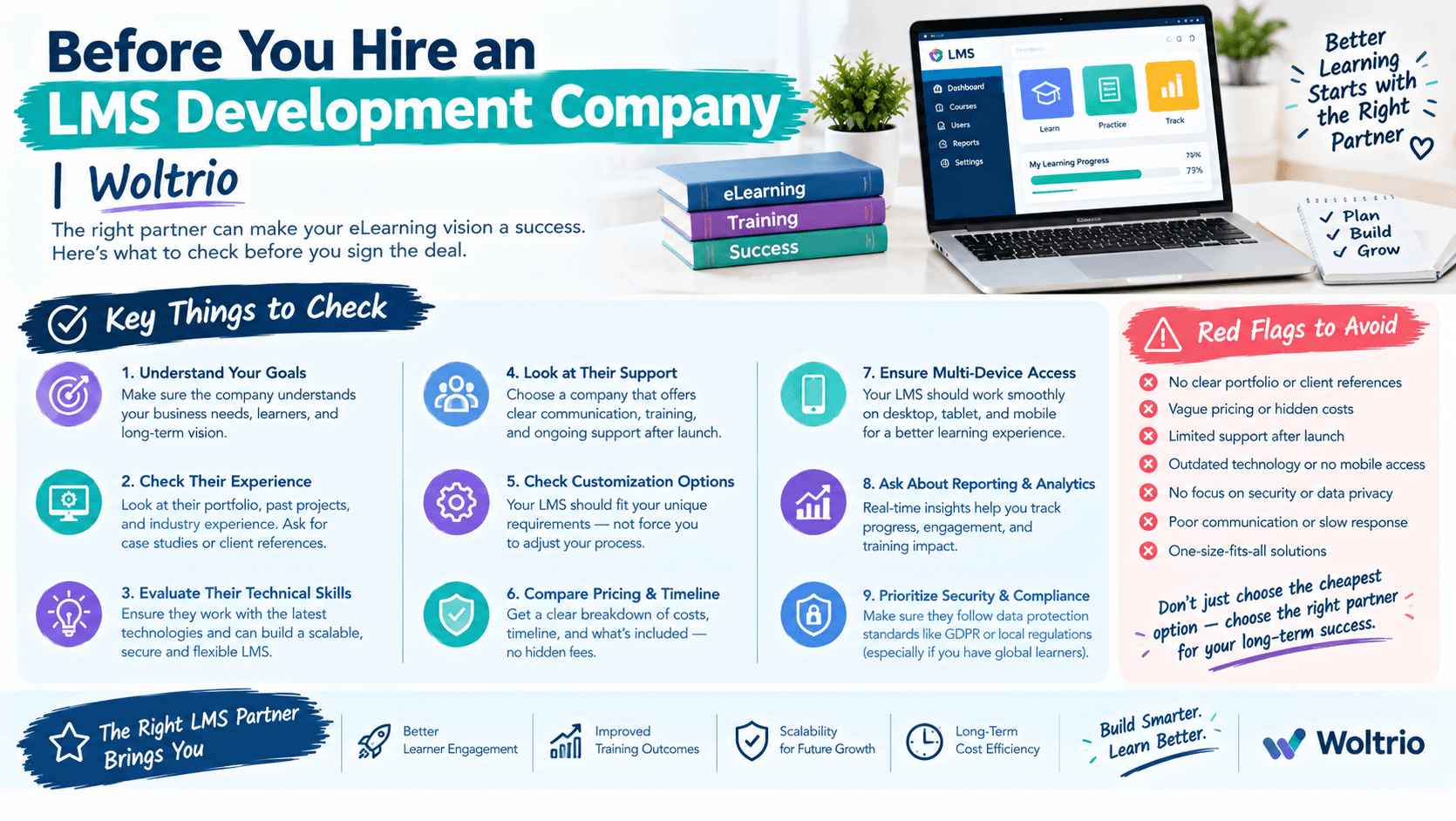
Most custom LMS projects lose weeks in the first month. The vendor is ready to start, but the organization cannot yet answer basic questions about its own training process. A little preparation before the first call changes that. This guide covers what to gather, who to involve, and what to decide ahead of time.
Step 1: Write Down How Training Works Today
Before describing the system you want, describe the process you have. Map it as it actually runs, not as the policy document says it should.
How does a new hire get their first training assignments?
Who assigns training, and how do they know what to assign?
What happens when someone changes roles or locations?
How are certification renewals tracked, and who gets notified?
Where does the real tracking live, in the LMS, a spreadsheet, or someone’s inbox?
Pay special attention to that last question. The workarounds your team has built are the clearest signal of what the current system fails to do. Woltrio asks about them in every discovery conversation because they point straight to the requirements that matter.
Step 2: List Every System the LMS Must Talk To
Integration is usually the biggest driver of cost and timeline in custom LMS development, so the vendor needs this list early. Gather the following:
What to CollectWhy It MattersHR system name and who administers itDetermines how staff records and role changes syncIdentity provider used for staff loginsDecides whether single sign-on is possibleTools used for scheduling or communicationAffects reminders and assignment notificationsExisting training content formatsShows whether current courses can be reusedAny reporting tools leadership already usesShapes how data should be exported
If you do not know the answer to a row, name the person who does. That alone saves a week of back and forth.
Step 3: Define What an Audit Needs
Ask your compliance lead one question: if a regulator asked for training proof tomorrow, what exactly would they need to see? Collect a sample of the last report you produced, even if it was assembled by hand. Note the fields, the format, and how far back the records had to go.
Compliance requirements are far cheaper to design in than to retrofit. For any organization handling sensitive staff or patient adjacent data, this is also the moment to name the frameworks that apply, such as HIPAA, SOC 2, or GDPR. Woltrio builds these requirements into the architecture from the start, but the vendor can only do that if it knows which ones are in scope.
Step 4: Involve the Right People Early
A custom LMS touches several teams, and each one catches different problems. Before kickoff, identify:
A training owner who understands assignment and certification cycles
An IT contact who can speak to identity, security, and system access
A compliance contact who knows the reporting requirements
A few frontline learners who can review early designs honestly
That last group is the one most often skipped. Learners decide whether the system gets used, so their feedback belongs in the design phase, not after launch. This is why Woltrio’s UI/UX design process puts real learners in front of prototypes early.
Step 5: Decide What Success Looks Like
Vague goals produce vague projects. Pick two or three outcomes you can actually observe, for example:
New hires start training on day one without manual assignment
Compliance reports are produced on demand instead of rebuilt by hand
Certification lapses are flagged weeks in advance
Completion rates rise in a specific department
These outcomes give the vendor something concrete to build toward and give you a way to judge the result. If automated reminders or escalations are part of the goal, say so, since that scoping affects how AI and automation gets applied to the project.
Step 6: Choose Your Starting Scope
You do not need to decide the whole system up front. A smaller first phase is often the smarter choice. Pick one department, one location, or one certification cycle and treat it as a pilot. Woltrio’s MVP development approach is built around this idea: prove one workflow with real users, then expand. It surfaces integration and design problems while they are still cheap to fix.
The One Page Brief
Pull everything above into a single page you can hand to any vendor:
A short description of how training works today, including workarounds
The list of systems the LMS must connect to, with owners
A sample compliance report and the frameworks that apply
The names of your training, IT, and compliance contacts
Two or three measurable success outcomes
Your proposed pilot scope
A vendor who reads this brief and asks sharp follow up questions is a good sign. A vendor who skips past it to a feature demo is telling you how the project will go.
What Happens After You Share the Brief
With a brief in hand, discovery moves faster. A typical custom LMS development engagement then runs through architecture planning, design with learner input, development tested against real scenarios, and a pilot launch before wider rollout. Single department builds often take a few months, while organization wide systems with deeper integration take longer. The preparation above is what keeps the early weeks productive.
Quick Answers
Before contacting an LMS development company, document how training really works today, including every workaround.
Integration details such as HR system, identity provider, and content formats drive much of the cost and timeline, so gather them first.
A sample compliance report tells the vendor exactly what the reporting layer must produce.
Frontline learners should review designs early, since their adoption decides whether the system succeeds.
A one page brief with a pilot scope helps vendors respond with specifics instead of generic proposals.
Common Questions
How long does it take to prepare before talking to an LMS vendor?
Most teams can gather the basics in one to two weeks, mainly by interviewing the training, IT, and compliance owners.
What if we do not know our integration details yet?
Name the person who does and share what you have. A good discovery phase fills the remaining gaps, but early answers speed everything up.
Do we need a finished requirements document first?
No. A short brief covering workflow, systems, compliance needs, and success outcomes is enough to start a useful conversation.
Next Step
A discovery conversation through the Woltrio homepage is a practical way to turn your one page brief into a scoped plan.