

























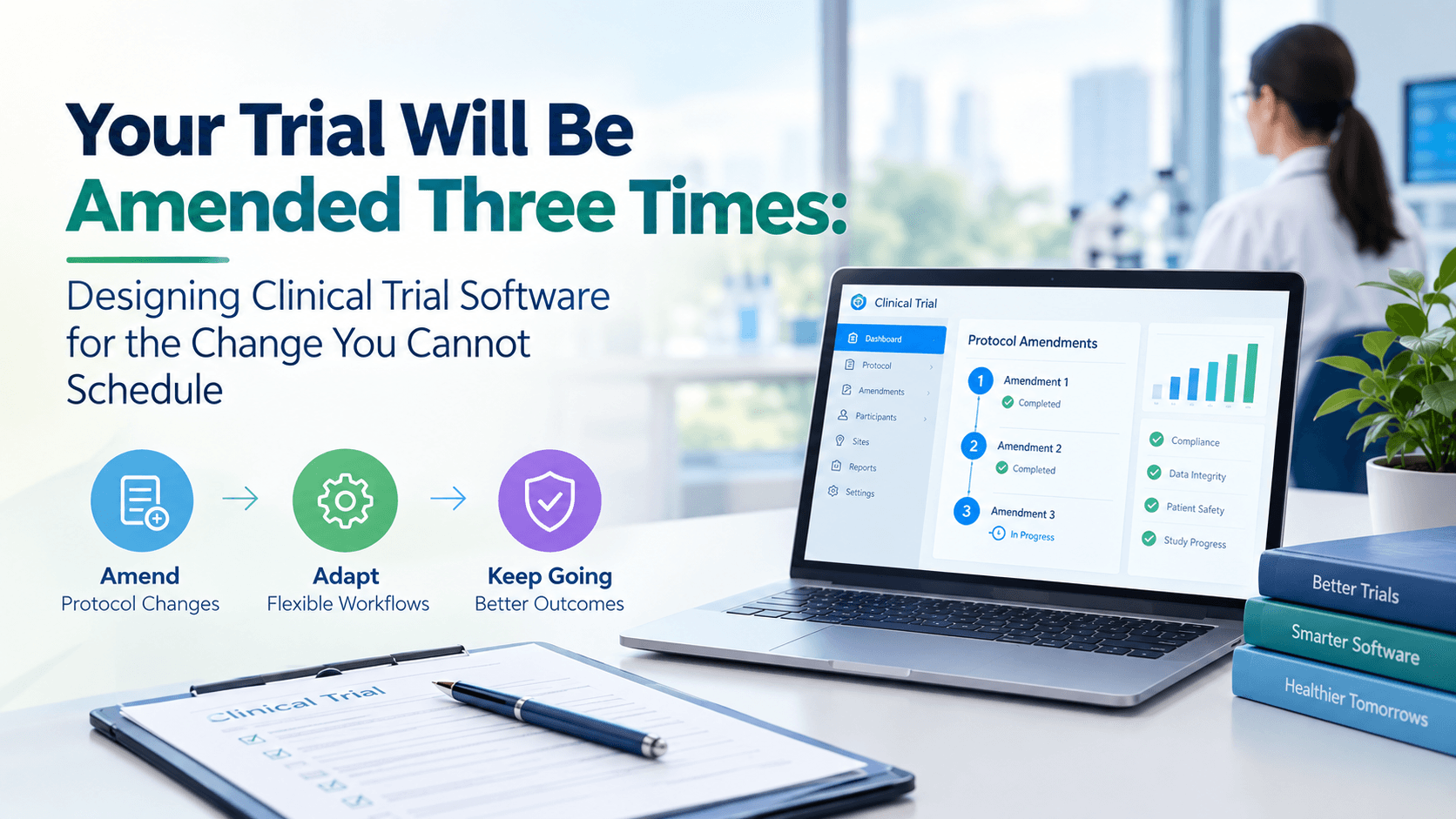
Every clinical trial software build starts from a document that is going to change.
That is not a criticism of protocol writing. It is the measured norm. Tufts Center for the Study of Drug Development benchmark research, published in Therapeutic Innovation and Regulatory Science, found that the share of Phase I to IV protocols carrying at least one amendment has risen from 57 percent to 76 percent, and that the mean number of amendments per protocol has risen roughly 60 percent, from 2.1 to 3.3. Seventy-seven percent of those amendments were judged unavoidable, driven mainly by regulatory agency requests and changes in study strategy.
So the amendment is not a risk to be mitigated. It is a requirement to be designed for. The useful question is not whether a protocol change is coming. It is what that change will cost depending on when it lands, and which decisions made before the first line of code was written set that cost.
This piece walks one ordinary amendment through five points in a build. Same change, five arrival times, five very different bills. Then it names the four architectural decisions that flatten the curve.
Key takeaways
Protocol amendments are near universal and mostly unavoidable, so a build that treats the protocol as a fixed input is mispriced from the start.
The same amendment can cost a specification edit or a reconstruction project depending only on when it arrives.
The hardest case is not the change itself. It is the period when different sites are running different protocol versions at the same time, which the Tufts research puts at an average of 215 days.
Four decisions set the whole cost curve: separating the data model from the form layer, making protocol version a property of the record, treating the audit trail as a deliverable, and keeping derivations out of capture.
The regulatory baseline has moved. ICH E6(R3) and the FDA's 2024 electronic systems guidance both raise what a system has to be able to demonstrate about its own history.
The planning assumption that breaks clinical trial software
Ask a team what their electronic data capture build covers and you will usually get a scope defined against a protocol version. Visit schedule, assessments, eligibility criteria, endpoints, edit checks. All of it specified from one document, at one moment.
The assumption underneath is that the protocol is an input. In practice it behaves more like a schema that gets migrated, repeatedly, while the system is live and holding regulated data that cannot be discarded or quietly rewritten.
Two numbers from the same Tufts research make the point. The average time from identifying the need to amend through to final oversight approval is 260 days. The average period during which investigative sites are operating under different versions of the same protocol is 215 days.
Read that second figure as a systems requirement rather than an operational inconvenience. For roughly seven months, a single study is collecting data under two sets of rules at once, and both sets are correct for the sites following them. Any system that models one active protocol version has already failed that requirement and will meet it later through spreadsheets, manual queries and reconciliation work.
Point one: the amendment arrives before database build
Cheapest case. The change is still a specification change.
What has to move: the data specification, the form designs, the edit check logic, the validation plan. Nothing has been built, so nothing has to be unbuilt. No data exists, so no data is at risk.
What it costs: analyst and data manager time, plus whatever the delay does to study start-up. Real money, but linear and predictable.
What makes it cheaper: almost nothing in the software. This is the point where the architecture does not matter much, which is exactly why teams that only ever experience amendments here conclude that amendments are cheap. They are drawing the curve from its lowest point.
Point two: the amendment arrives after build, before first patient in
Still manageable. The system exists, validated, with no production data in it.
What has to move: forms are rebuilt, edit checks are revised, the validation evidence is regenerated, and the user acceptance testing is run again. If study data standards mapping has already been done, that mapping is revisited too.
What it costs: rework of a completed build plus a second validation cycle. The validation cycle is often the larger line item, because it is the part that cannot be shortened by working faster.
What makes it cheaper: configuration over code. A build where visit schedules, form definitions and edit checks are data rather than hard-coded logic can absorb this change as configuration edits with a targeted revalidation, instead of a development sprint followed by a full regression pass. The same principle governs any system where the questions change more often than the database should, which is why we build intake forms software the same way.
Point three: the amendment arrives after enrolment opens
This is where the curve turns.
What has to move: everything from point two, plus a decision about the data already collected. A new assessment added at week four has no historical value for participants already past week four. A changed eligibility criterion raises questions about participants enrolled under the old one. A revised endpoint definition may change what the collected data means rather than what it contains.
What it costs: the rework, the revalidation, and the analysis work to establish what the existing records now represent. Add the query burden on sites, because anything ambiguous arrives at the coordinator's desk.
What makes it cheaper: the single most valuable property here is that no record ever loses the context it was captured under. If each stored value carries the protocol version, form version and edit check version in force when it was entered, the question "what does this record mean" is answerable from the database. If it does not, the answer has to be reconstructed from change logs, emails and memory.
Point four: the amendment arrives and sites adopt it at different times
The 215-day case, and the one most builds handle worst.
Amendments do not reach all sites at once. Institutional review board and ethics committee approval timelines differ, site training schedules differ, and some sites have participants mid-visit-window when approval lands. For most of a year, a multi-site study is genuinely running two protocols.
What has to move: the system has to hold both versions as simultaneously valid, route each participant to the correct one, and keep them from contaminating each other. Monitoring and reporting have to answer questions across both. The statistical analysis plan has to tolerate a population split by version rather than by randomisation.
What it costs: if the architecture allows it, the amendment cost is configuration plus coordination. If it does not, the usual response is one of three bad options. Force all sites onto the new version before they are approved for it, which is a protocol deviation. Keep all sites on the old version until the slowest one is ready, which wastes the amendment. Or run the new version in a parallel study build and reconcile afterwards, which is the most expensive of the three and the one most often chosen because it looks safest.
What makes it cheaper: treating protocol version as a dimension of the data rather than a state of the study. A participant belongs to a site, a site is approved for a protocol version from a given date, and a record belongs to the version in force for that participant at that moment. Expressed that way, the concurrency is ordinary. Expressed as a global setting, it is a crisis.
Point five: the amendment arrives after database lock
Rarest and most expensive, usually driven by a regulatory agency question during review.
What has to move: unlocking a locked database, making the change, re-running derivations, regenerating the submission datasets, and documenting every step to a standard that will survive inspection. The technical work is often small. The evidence work is not.
What it costs: proportional to how well the system can explain itself. A platform that can produce a complete, tamper-evident record of what changed, when, by whom and under what authorisation turns this into a documented procedure. A platform where the audit trail was built for debugging turns it into forensics.
What makes it cheaper: everything decided in the first week of the build.
The four decisions that set the whole curve
Across all five points, the same four decisions keep appearing.
Separate the data model from the form layer
A form is a way of collecting a value. It is not the value. When form layout and data definition are the same object, every cosmetic change to a page is a change to the database, and every database change requires revalidation. Keeping them separate means a reworded question is a form version change and nothing more, while a genuinely new variable is handled as the schema change it actually is.
Make protocol version a property of the record
Not a study setting, not a site setting, a record property. This is the decision that makes point four survivable, and it is close to impossible to retrofit once several thousand records exist without one. It also happens to be what makes the regulatory story simple, because every value can state the rules it was collected under.
Treat the audit trail as a deliverable
The audit trail in a trial system is evidence rather than diagnostics. It has to be complete, attributable, tamper-evident, retained, and reviewable by someone who was not there. This is the same discipline that governs record-level logging in custom EMR and EHR software development, where the requirement is set by what a reviewer must be able to reconstruct and not by what an engineer needs in order to debug.
Push derivations downstream
Calculated values written into captured records at entry time are a liability, because an amendment that changes a derivation rule leaves historical records carrying numbers that cannot be reproduced from their inputs. Keep capture raw and compute derivations in a layer that can be re-run against any version of the rules. That separation is what makes submission dataset generation repeatable rather than artisanal, and it is the same architecture that sits under a working healthcare data analytics platform.
What the regulations require of the system
Three things have shifted, and all three raise the bar on a system's ability to account for its own history.
ICH E6(R3) replaced E6(R2) and takes effect in stages. The Principles and Annex 1 became effective in the European Union on 23 July 2025. Annex 2, covering decentralised and pragmatic trials and the use of real world data sources, reached Step 4 in June 2026 and becomes effective on 15 January 2027. R3 treats data governance across the full data lifecycle as a named sponsor responsibility and addresses computerised system validation, access control and audit trail integrity more explicitly than R2 did, with the level of control expected to be proportionate to risk rather than uniform.
The FDA finalised its questions and answers guidance on electronic systems, electronic records and electronic signatures in clinical investigations on 2 October 2024, superseding the 2007 computerised systems guidance. It expands the risk-based approach to validation, updates expectations on data integrity and audit trails, addresses agreements between sponsors and IT service providers, covers data collection from digital health technologies, and clarifies how 21 CFR Part 11 applies to real world data sources and to investigations conducted outside the United States.
At submission, study data has to arrive in the standards named in the FDA Data Standards Catalog, with conformance set out in the Study Data Technical Conformance Guide. That requirement reaches back into the build, because a system that cannot map cleanly to submission standards creates transformation work at exactly the moment when there is least time for it.
Decentralised designs add a participant-facing surface to all of the above. Consent, reported outcomes and visit scheduling move onto the participant's own device, which puts the same versioning question into territory that looks much more like patient portal software development than like classic site-based data capture.
None of this is legal or regulatory advice. It is engineering guidance on what the current framework asks a system to be able to show, and the determinations themselves belong with regulatory and quality colleagues.
What to ask before you sign a build contract
Five questions, each of which has a cheap answer and an expensive one.
Can two protocol versions be active at the same time, with sites assigned individually? Can a single record state which protocol and form version it was captured under? Is a form change a configuration edit or a code change, and what revalidation does each trigger? Are derived values stored at capture or computed downstream? Can the system produce a complete change history for any record without a developer writing a query?
A vendor or partner who answers these with a demonstration rather than a roadmap has built this before. At Woltrio we treat these as architecture decisions rather than features, because the point four scenario is not an edge case. It is 215 days of most studies.
Teams planning a research platform alongside other products usually find the same questions recurring across their estate, which is why our healthcare software development services start from data architecture rather than screens. Trial systems rarely live alone.