





















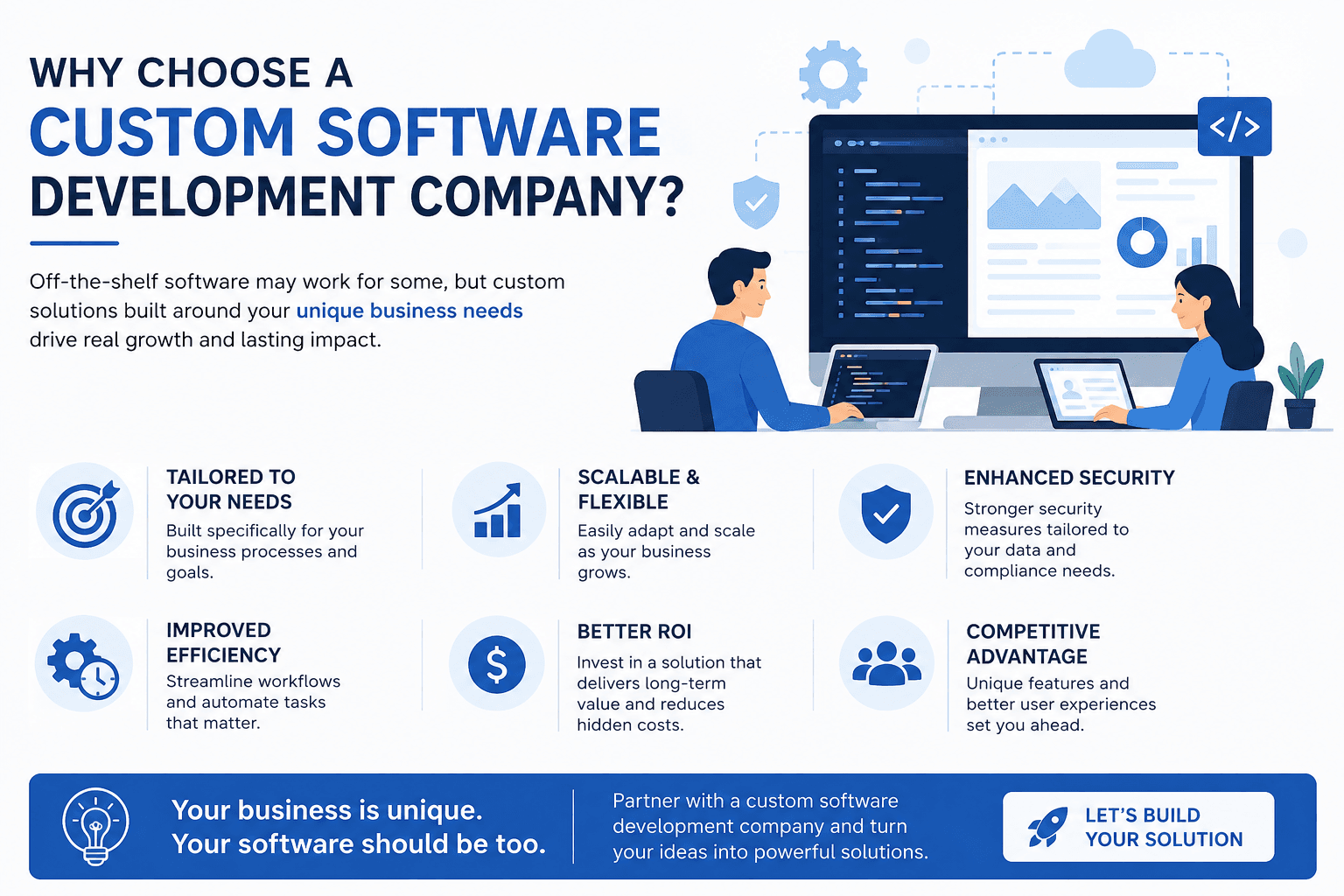
A custom software development company builds software around your workflow instead of asking you to adapt your workflow to someone else's product. You get code you own, systems that fit how you already work, and a partner who is still there when the requirements change.
That answer has been true for twenty years. What changed in 2026 is the reasoning behind it, and most content on this topic has not caught up.
AI assisted development compressed the routine portion of a build. Internal tools that took a quarter now take days. That genuinely reopened the build question for a lot of organisations. But it changed only one side of the equation, and the side it did not touch is the expensive one.
Benefits of Custom Software
The benefits worth paying for are the ones that persist after launch. Four hold up.
The software matches the workflow that makes you money. The useful principle here is simple: buy the commodity, build the differentiation. Payroll is a commodity. The process your competitors cannot copy is not. Custom software solutions earn their cost when they sit on the second kind.
You own the asset. Owned code is a balance sheet item and a negotiating position. Licences are neither. Subscription creep as seats, modules, and usage expand is one of the most predictable costs in enterprise software.
Integration is designed rather than discovered. Off the shelf products connect to what their vendor decided to support. Custom systems connect to what you actually run, which matters most in organisations carrying legacy systems that no connector reaches.
It changes when you change. A vendor roadmap serves the average customer. If your requirements move faster than that average, you spend years waiting for features and building workarounds in the meantime.
Notice what is absent from that list. Speed of initial delivery is no longer a differentiator, because AI compressed it for everyone, and the gain shrinks anyway on genuinely novel or complex logic where the time savings fall away.
Development Process
A credible process has four phases, and the discipline is in the gates rather than the labels.
Discovery. What the software has to do, what it connects to, and what success looks like as a measurable statement. Estimates issued before this exists are decoration.
Architecture and data model. The schema decides what is possible later. This is where backend development and cloud engineering decisions get made, and it is the cheapest possible moment to get them right.
Build and iterate. Working software in front of real users early. Where scope is genuinely uncertain, a scoped MVP answers the question faster than a longer specification does. UI and UX design belongs in this phase, not after it, because an unused system produces no value regardless of how well it was engineered.
Run. Monitoring, patching, and a roadmap owner. Treated as a phase, not an afterthought.
One warning about speed. AI assisted delivery is fast, and speed to demo misleads. Teams consistently find the last 20 percent, meaning security, observability, performance, reliability, data quality, and change management, is still 80 percent of the effort. A demo that took a week does not imply a system that takes a month.
There is a useful check on the hype here. In a randomised trial published in July 2025, experienced developers working in mature codebases believed AI tools made them around 20 percent faster. Measured, they were roughly 19 percent slower. Those were early 2025 tools and the picture has moved since, but the finding is a reasonable corrective to any partner who sells AI velocity as the whole story.
Choosing the Right Partner
Five questions separate a software development services vendor from an actual partner. Ask them in a first call.
What does your discovery produce, and what does it cost? A partner who quotes before discovery is guessing, and you will pay for the correction.
Who owns the code and the intellectual property? The answer should be you, with full source handover. Anything else is a lock-in structure wearing a services label.
How do you use AI in delivery, and who reviews the output? AI generated code shipped without architectural review multiplies technical debt rather than removing it. You want a named review process, not a tool list.
What does support look like in year two? This is the question that predicts total cost better than any line in the estimate.
What would you tell us not to build? A partner who has never talked a client out of scope has never had the client's interests ahead of the invoice.
That last question is the most revealing one on the list. Every custom software development company can describe what it builds. Far fewer can tell you where custom is the wrong answer.
When buying still wins
Custom is not the default, and any custom software development company that pretends otherwise is selling rather than advising.
Buy when a thousand other organisations have the same need. Specialisation is real, and a mature product built once for many customers will beat an internal rebuild of the same commodity. Buy when your team has no capacity to own software after launch. Buy when the requirement is stable, well understood, and not connected to how you compete.
The decision is no longer even two ways. Most enterprise choices now run three ways: build custom, buy a product, or buy a platform and extend it through APIs and configuration. That third path is frequently the right one and is the least discussed, because neither software vendors nor development agencies have an obvious incentive to recommend it.
Pick wrong in either direction and you inherit one of two problems. Technical debt from a build nobody wants to maintain, or subscription sprawl from a purchase nobody governs.
The question that actually decides it
Before anything else, label what you are doing. Building to learn and building to run are different activities with different economics.
Build to learn covers prototypes, experiments, and internal leverage tools. Speed matters, polish does not, and disposability is a feature. AI assisted development transformed this category, and it is where the dramatic time savings are real.
Build to run covers production systems with uptime expectations, audit requirements, security obligations, and a decade of maintenance ahead. AI helps here too, but far less, because the hard parts were never the routine code.
Organisations that do not label which one they are doing end up treating prototypes as products and paying for it later. It is the most common expensive mistake in the current market, and it has become more common precisely because building got easier.
Then model the real cost. Maintenance runs roughly 60 to 80 percent of the total cost of owning custom software across five years, a benchmark that has stayed remarkably stable from classic software engineering research through current analyst work. Any business case built on development cost alone is answering the wrong question, and most internal build versus buy models still run on pre 2023 assumptions.
Where Woltrio fits
Woltrio builds custom software solutions for organisations whose workflow genuinely differs from what the market ships, with a focus on regulated and healthcare environments where the last 20 percent is most of the work.
That focus is the reason the questions above are worth asking. In regulated settings, security architecture, audit trails, and failure handling are not polish applied at the end. They shape the system from the first week, which is exactly the category of work where fast building helps least and an experienced partner helps most. Woltrio's AI development and workflow automation practice sits inside that discipline rather than around it.
Most engagements start with a scoped discovery, because the honest answer to whether you should build is sometimes no, and finding that out early costs a fraction of finding it out late.
Start with a scoped discovery from Woltrio.