

























Every product team has the same reflexes. Remember the user. Authenticate once per session. Reduce the number of taps. Single sign-on across the suite.
In electronic prescribing of controlled substances, most of those reflexes are either prohibited outright or have to be engineered around rather than satisfied. EPCS is the one corner of healthcare software where the usual direction of good design runs against the requirement, and teams that do not understand that early build something they have to take apart.
The rules come from the DEA under 21 CFR Part 1311 rather than from HIPAA, which is why they feel unfamiliar to teams whose compliance instincts were formed elsewhere. HIPAA asks whether access is appropriately controlled. The DEA rules ask something closer to whether this specific prescription can be proven to have been signed by this specific, verified human, and whether that proof survives scrutiny later.
A necessary caveat. This is engineering guidance, not regulatory or legal advice. EPCS obligations also vary by state on top of the federal baseline, and whether a specific implementation satisfies them is a question for counsel and for the third-party auditor who will assess it. What follows is about the build consequences, which are the part most often discovered late.
What the rules actually require
Four pillars, stated plainly, because most summaries of EPCS stop at "you need two-factor."
Identity proofing at IAL2. Prescribers must be verified before they can issue controlled substance prescriptions, at Identity Assurance Level 2. In practice that means live facial capture with liveness detection, validation of a government-issued ID, biometric matching, and address confirmation. This is identity verification at a level nothing else in a typical healthcare product requires.
Two-factor authentication at signing. Required under 21 CFR 1311.115, and this is the detail that reshapes the product: the second factor is presented per prescription, not per session. Acceptable factors include a hardware token, an authenticator app on a separate device, or biometrics meeting the standard.
Cryptographic signing. Each prescription is signed using the prescriber's private key held in a FIPS 140-2 validated module. Any change to the prescription after signing breaks the signature, which is the point.
Third-party audit and recertification. The application must be audited or certified against 21 CFR Part 1311, with recertification every two years, and must maintain logs demonstrating ongoing compliance rather than compliance on the day of assessment.
Read those together and the shape becomes clear. The regime is built to reproduce, digitally, the chain of custody that a signed paper prescription pad provided. Non-repudiation is the requirement. Convenience is what non-repudiation costs.
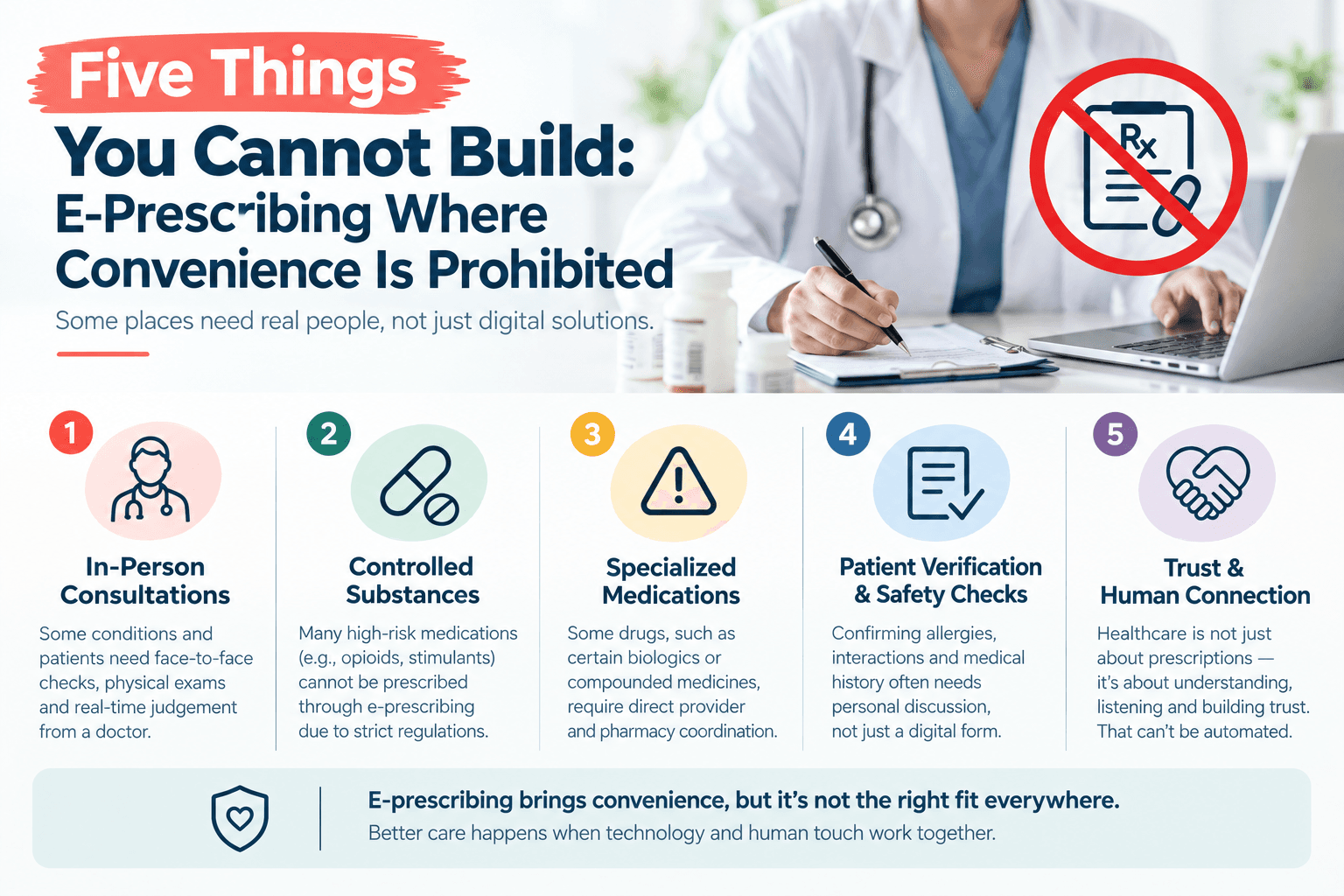
Five things you cannot build
Each of these is a normal instinct, why it does not survive here, and what you build instead.
1. A remembered session
The instinct. Authenticate once, stay signed in for the clinic day, and keep the prescriber moving.
Why it fails. The second factor is required at the point of signing each prescription. A prescriber writing thirty controlled substance prescriptions in a session authenticates thirty times. There is no session-level shortcut that satisfies the requirement.
What you build instead. The fastest possible per-signature flow. If the second factor is a biometric on a device already in the prescriber's hand, thirty authentications is an irritation. If it is a code typed from a token in a drawer, it is a reason the product gets abandoned. The requirement is fixed; the time each instance takes is entirely a design decision, and it is the single highest-leverage one in the product.
2. Batch signing as a shortcut
The instinct. Let the prescriber review a queue and sign everything at once.
Why it fails. Whatever the interface shows, each prescription needs its own authentication event. Batch signing that collapses to a single authentication does not meet the requirement.
What you build instead. A batch review flow where the clinical review is genuinely batched and the authentication is not. The prescriber reviews the set, then authenticates per item in a tight loop. That preserves the useful part of batching, which is reviewing in context, without pretending the authentication can be shared.
3. Delegated signing
The instinct. A nurse or medical assistant prepares and sends the prescription, as happens with plenty of other clinical tasks.
Why it fails. The signature must be the prescriber's, produced with their credential and their second factor. Staff can prepare. Staff cannot sign.
What you build instead. A clean separation between preparation and signing, with the prepared prescription queued to the prescriber and the signing step unambiguously theirs. The failure mode to design against is a workflow where a shared credential makes delegated signing technically possible, because that is the arrangement that turns up in an audit.
4. Generic single sign-on across the product
The instinct. One identity provider, one login, consistent across every module.
Why it fails. Not because SSO is prohibited, but because the EPCS credential carries requirements the rest of the product does not, including the IAL2 proofing behind it and the per-signature factor in front of it. Flattening it into the general authentication model means either over-engineering everything else or under-engineering this.
What you build instead. A separate credential path for prescribing, explicitly modelled as such, sitting alongside the general authentication rather than inside it. That is an architecture decision, and retrofitting it means touching the identity layer of a live clinical product.
5. A logging approach designed for debugging
The instinct. Log enough to troubleshoot, rotate aggressively, keep storage costs down.
Why it fails. The audit trail here is evidence rather than diagnostics. It has to demonstrate ongoing compliance across the period between certifications, which means it must be complete, tamper-evident, and retained.
What you build instead. An audit log designed as a record from the start, separate from application logging, with integrity protection and a retention policy set by the requirement rather than by storage budget. This connects directly to the broader point that protected health information accumulates in log stores, which is a problem in the opposite direction: EPCS logs must be kept, and must also be kept safely.
The obligation nobody budgets for
Recertification every two years.
This is the part that surprises companies, because the first certification is treated as a launch cost and then the product evolves. Two years later the application being recertified is not the application that was certified, and the delta is whatever the roadmap delivered in the meantime.
Teams that handle this well treat the certified behaviours as a protected surface: changes to the identity, signing, or audit paths go through a heavier review than ordinary feature work, and the evidence needed for recertification is produced continuously rather than assembled in a panic. That discipline is the same one described in the requirements spec for remote monitoring and in the clinical AI runbook, and it is the recurring theme across regulated healthcare software: the compliance artifact has to be a by-product of how you build, because reconstructing it afterwards is both expensive and unconvincing.
What to settle before building
Four questions.
Are you building EPCS or integrating it?
Many products route controlled substance prescribing through a certified third party rather than certifying their own application. That is frequently the right answer and it changes the entire scope. Decide deliberately rather than by drift.
What is the second factor, realistically, for your users?
Not the most secure option. The one a prescriber will actually have in hand thirty times a day. This decision determines whether the product is used.
Where does the prescribing credential sit in your identity architecture?
Answered at design time, or answered painfully later.
Who owns recertification, and what is the change control on the certified paths?
If the answer is nobody yet, that is the finding.
Where Woltrio fits
Woltrio builds prescribing and clinical workflow software and the integration underneath it, including the parts where the regulatory requirement and the interface design are the same problem.
In practice the work is the per-signature flow, which is where a compliant product becomes a usable one, the identity architecture that keeps the prescribing credential correctly separated, and the audit infrastructure that makes recertification an export rather than a project. Where a product routes to a certified third party instead, the work is the integration and the workflow around it, which is backend development and custom EMR and EHR development rather than a certification exercise. Where the constraint is making thirty authentications a day tolerable, it is squarely UI and UX design. The wider capability set sits under services.
The summary worth keeping: in most software, friction is a defect. Here a specific friction is the requirement, and the engineering job is to make the required friction as small as it can legally be rather than to remove it. Products that understand that distinction get used. Products that fight it get worked around, and a worked-around prescribing system is a compliance problem rather than a usability one.
Start with a scoped discovery from Woltrio.