

























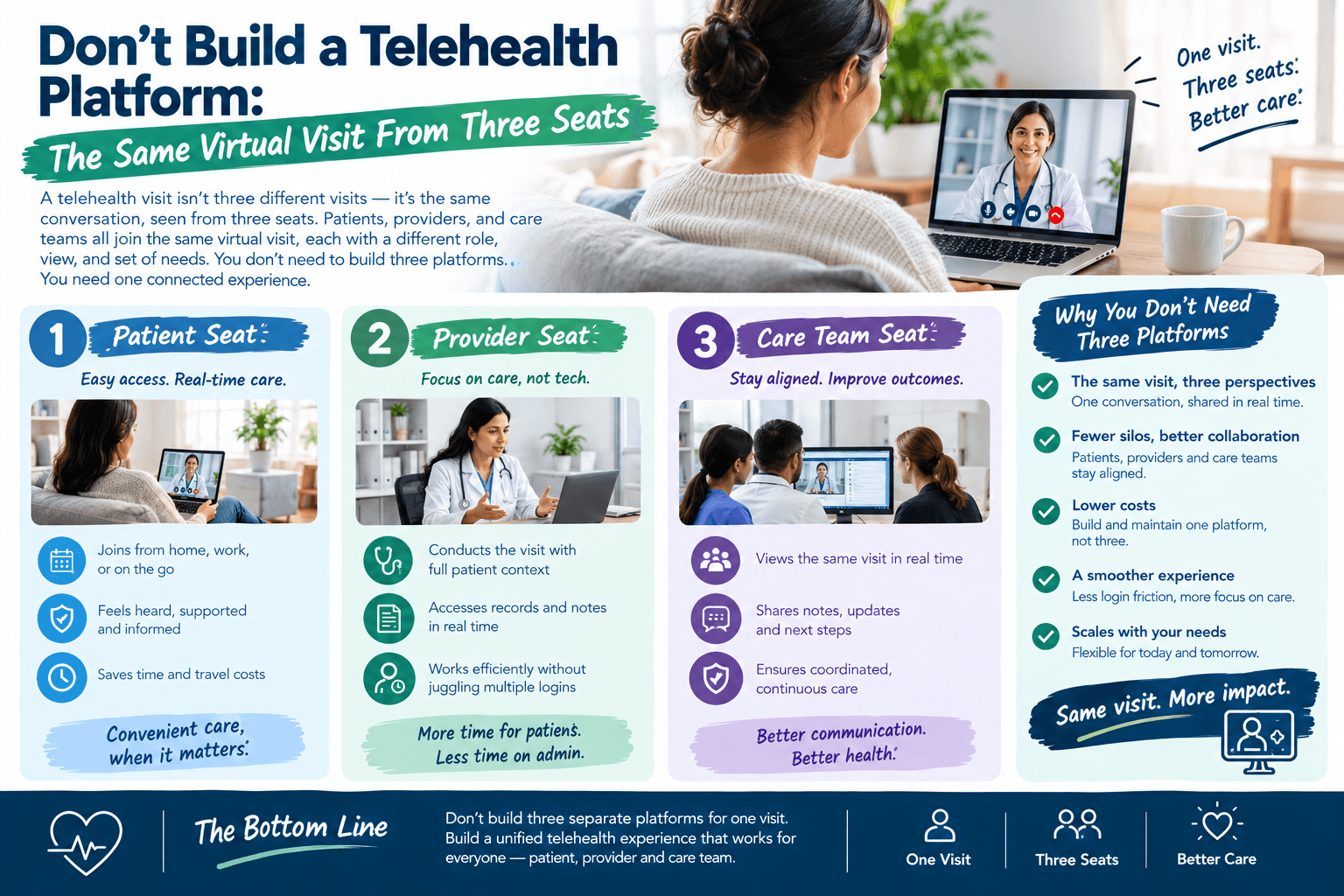
Telehealth has finished its transition from venture-backed growth category to plumbing.
The arc is unusually well documented. Virtual care claims spiked to roughly 78 times pre-pandemic levels at the peak, then settled into a durable equilibrium around 38 times the pre-2020 baseline. Outpatient and office visit virtualisation has stabilised somewhere between 13 and 17 percent across specialties. That is not a collapse and it is not a revolution. It is a channel finding its level.
The commercial consequence is sharper than the usage numbers suggest. When health systems first went virtual there was no native infrastructure, so they bought third-party video. The record system vendors then built it themselves, and enterprise virtual care products now launch inside the clinician's chart through SMART on FHIR rather than sitting in a separate tab. Video became a feature of the record system.
Meanwhile the buyers started cutting. Around half of large employers are running RFPs specifically to consolidate their digital health vendor landscape, and roughly two thirds of CIOs are targeting at least a twenty percent reduction in digital health contracts.
So the advice most healthcare content still gives, compare the best telehealth platforms and pick one, answers a question that has largely closed. The more useful question is what to build around video now that video itself is commodity. And the answer depends entirely on which seat you are sitting in.
Seat one: the provider organisation
What success looks like here. Capacity. A virtual visit is valuable to a provider organisation if it moves a patient through the system faster, fills a slot that would otherwise go empty, or avoids a journey that was never clinically necessary.
What actually goes wrong. Workflow strain, not technology failure. A clinician running a hybrid session list needs the same chart, the same order entry, and the same documentation path regardless of modality. Every context switch between systems costs time, and time is the only thing the virtual channel was supposed to save.
This is why the standalone platform lost. Not on video quality, which converged years ago, but because a product outside the record system asks a clinician to work in two places. That makes the integration work more decisive than any feature comparison, which puts it in custom EMR and EHR development and backend development territory rather than in video engineering.
The build implication. The deliverable is modality-agnostic workflow, not a video product. If your system treats a virtual visit as a different kind of object from an in-person one, every downstream process has to handle both, and the branching is where the cost lives.
Seat two: the payer
What success looks like here. Substitution. A virtual visit is valuable to a payer if it replaces something more expensive, typically an avoidable acute episode.
What actually goes wrong. Addition rather than substitution. Low-acuity virtual visits that would not otherwise have happened are new utilisation, not avoided cost, and payers watch for exactly this pattern. Coding and documentation scrutiny follows.
This is the part product teams routinely miss. A feature that improves access for a provider can weaken payer economics at the same time, and when it does, the reimbursement environment tightens around it.
The build implication. Documentation and coding support for virtual encounters is not administrative overhead bolted onto the product. It is what determines whether the channel stays reimbursed. Systems that capture the clinical rationale and the modality decision as structured data are defensible; ones that record a video call happened are not.
Seat three: the builder
What success looks like here. Being load-bearing. A product either sits inside the record, claims, and care management workflow, or it sits beside it.
What actually goes wrong. Winning users and losing relevance. A vendor can add users quickly and still fail commercially if its product sits outside those three workflows, because it becomes a line item during exactly the consolidation exercise described above. When a CIO is cutting twenty percent of digital health contracts, the tools that survive are the ones something else depends on.
The build implication. Interoperability is not a feature that improves your product. It is the thing that keeps your product on the estate. Anything that reads from and writes into the record system through FHIR has a structural defence that a better interface does not provide.
Where the three seats conflict
This is the section that matters, and almost nothing published about virtual care addresses it.
The seats do not want the same thing, and a product optimised for one can actively damage another.
Maximum convenience for patients raises utilisation, which the provider may welcome as capacity used and the payer may read as demand induced.
Deep record system integration protects the builder's position and reduces the provider's optionality, which is precisely why procurement resists it.
Reduced documentation burden helps the clinician and weakens the evidence trail the payer relies on.
Designing as though these align produces a product that demos beautifully and stalls in procurement. The teams that get this right pick a seat deliberately, state the trade they are making, and instrument the metric that seat actually cares for. Which usually means the analytics layer matters more than another feature, and that sits with healthcare data analytics platform work.
What to build instead of a telehealth platform
Four things, all of which assume video is solved.
Modality-agnostic scheduling and intake. One path that handles both visit types, rather than two systems that meet at a report. This is where most of the recoverable staff time sits, and it connects directly to the pre-visit work covered by intake and registration systems.
The hybrid handoff. Patients move between virtual and in-person within a single episode of care. The transitions are where context gets lost, and the documentation of why a modality changed is both a clinical safety matter and a reimbursement one.
Continuous data alongside episodic visits. Remote monitoring and virtual visits are the same programme viewed at different intervals, and they increasingly share a data layer. Building them as separate products duplicates the hardest part twice.
An interface that survives a bad connection. Unglamorous, and it is the difference between a completed visit and an abandoned one for the patients with the least reliable access. That is a UI and UX design problem rather than a video engineering one.
Where Woltrio fits
Woltrio builds the workflow and integration layers around virtual care rather than video infrastructure, which is the work that still has value now that the video itself does not differentiate anything.
In practice that means record system integration so a virtual encounter behaves like any other encounter, scheduling and intake that do not fork by modality, and the data layer that lets an organisation actually answer whether the channel is substituting for cost or adding to it. Where a health tech company is still establishing whether its product can be load-bearing in a customer's estate, a scoped MVP integrated against one real record system answers that faster than a longer roadmap. The wider capability set sits under services.
The honest summary is that telehealth became boring, and boring is where the durable work is. Infrastructure outlasts categories.
Start with a scoped discovery from Woltrio.