























A regional group with eleven locations asked us a simple question last year. How many hygiene appointments did we book across all sites in March?
Nobody could answer it. Not because the data was missing, but because it sat in eleven separate databases, one per office, each running its own copy of the same platform. Getting the number meant someone opening eleven reports and typing the results into a spreadsheet. That person existed. That was their Monday.
This is the conversation nobody has in the dental practice management software category, because almost everything published about it is a product roundup. Search the term and you get the same seven platforms ranked by whoever wrote the page, often a vendor ranking itself. Useful if you are buying your first system. Useless if you already have one and it has stopped keeping up with you.
Start with the one number that survives scrutiny
Dental consolidation statistics are a mess, and it is worth knowing that before you plan around them.
You will see claims that 39 percent of dental offices are group affiliated. You will see market forecasts putting the software category at 2.62 billion dollars this year, and other forecasts putting it at 3.3 billion. These numbers use different denominators, different definitions of affiliation, and different vendor scopes. Several trace back to content marketing rather than research.
The figure that holds up comes from the ADA Health Policy Institute, which runs close to a census of practising dentists rather than a survey panel. It puts DSO affiliation at 16.1 percent of US dentists in 2024, roughly double the 2017 rate. More than a quarter of dentists within ten years of dental school are affiliated. Practice ownership fell from 84.7 percent in 2005 to 72.5 percent.
That is a slower curve than the marketing numbers suggest, and a much more useful one. It tells you consolidation is generational rather than sudden. Groups are forming steadily, mostly from younger dentists, and they are inheriting technology stacks designed for single offices.
The problem is architecture, not features
Every platform in this category does scheduling, charting, claims, and ledgers. Feature comparison tables tell you almost nothing, which is why they all look identical.
The split that matters is where the database lives. Server based systems, including classic Dentrix and Eaglesoft, put a database inside each office. That works beautifully for one location. At six locations it means six islands, six backup routines, six failure points, and no native way to see the group as a whole. Cloud native systems centralise the data, which is what makes real cross location reporting possible at all. Open Dental sits deliberately in the middle, self hosted by default but deployable to cloud infrastructure with the right architecture, and it exposes the most open integration surface in the category.
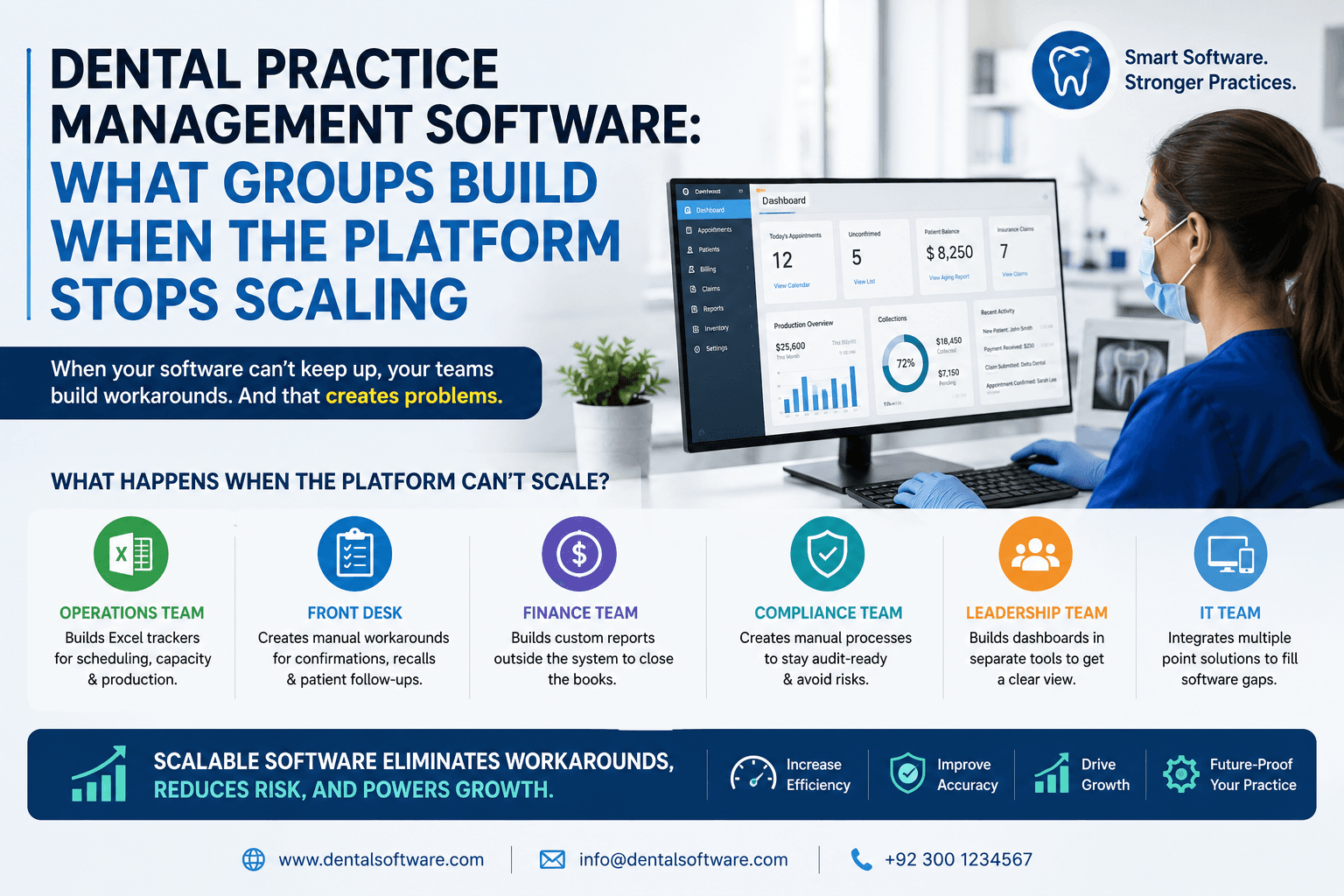
So when a group tells us their dental practice management software cannot scale, they usually mean one of two things. Either the data is distributed and they need it unified, or the platform is fine and the workflow around it is held together by staff doing manual work. Those are different problems with different price tags, and telling them apart is most of what a good discovery session does.
The four builds groups actually commission
Across dental engagements, requests cluster into four shapes. Almost nothing falls outside them.
The reporting layer. Read only extraction from every location into a single warehouse, refreshed nightly, feeding one dashboard. This is the most common first project and the cheapest meaningful win. It does not touch the clinical system, which keeps the risk profile low. It is also the build that ends somebody's Monday spreadsheet ritual.
The referral pipeline. This one belongs to specialty groups, and it is badly underserved. Endodontic, periodontal, and oral surgery organisations depend on referrals from general dentists, and that handoff usually happens by fax, phone, or a portal nobody logs into. Specialty clinical software is vendor specific per discipline, so generalist platforms ignore the connection entirely. Building it is unglamorous and unusually high value.
The revenue cycle bridge. Eligibility checks, claim status, and payment posting are where staff time disappears. Most platforms leave explanation of benefits posting and reconciliation as manual work. This is the natural home for workflow automation and increasingly for AI development, because the task is high volume, rule bound, and measurable.
The patient front door. Booking, intake, forms, and reminders, built once and consistent across every location, rather than whatever each office negotiated with its own vendor. Groups care about this because inconsistent patient experience across sites undermines the point of being a group.
Woltrio's dental practice management software work sits in all four, and the sequence matters. Reporting first, because it is low risk and tells you where the real losses are. Everything else gets prioritised by what the data reveals.
The migration trap
The instinct when a platform stops scaling is to replace it. Sometimes that is right. Usually it is the most expensive available option.
Consider the scale involved. Heartland Dental migrated roughly 1,800 sites to a single cloud platform in 2024 and reported a 37 percent reduction in IT tickets and 22 percent lower licence costs afterwards. Those are excellent numbers. They also came from an organisation with a dedicated platform engineering team, which is precisely the resource the top handful of DSOs have and nobody below them does.
For a group with eight to forty locations, a full platform migration means retraining every front desk, revalidating every clinical workflow, and carrying dual systems through a transition that will take longer than promised. The switching cost is the hidden line item in every comparison article, and it is the one they consistently understate.
Building a layer on top of what you already run is not always the answer. But it is the option most groups never seriously price, because the entire published discourse in this category is written by people selling replacements.
When building is the wrong call
Three situations where we tell groups not to build.
If you run fewer than four locations on a cloud native platform, your reporting problem is probably a configuration problem. Fix that first and save the budget.
If your team has no technical owner, custom software becomes an orphan the moment the engagement ends. Someone internal has to own it, even part time.
And if the underlying platform is genuinely end of life, a layer on top just postpones the reckoning while adding a second thing to migrate later.
Honest scoping means saying this out loud during discovery rather than after the invoice. A scoped MVP exists partly to find out which of these applies before anyone commits to a full programme.
What this means if you are the one with the spreadsheet
The group with eleven locations did not replace their platform. They kept it, and Woltrio built the extraction and reporting layer underneath, using backend development and cloud engineering rather than a clinical migration. The Monday ritual ended. The platform question got deferred by three years, which is exactly how long they needed.
That is the unglamorous version of dental software strategy, and it is the one that survives contact with a real practice. If your dental practice management software is holding data you cannot see, the first conversation is about the data, not the platform.
Start with a scoped discovery from Woltrio's dental technology team.