

























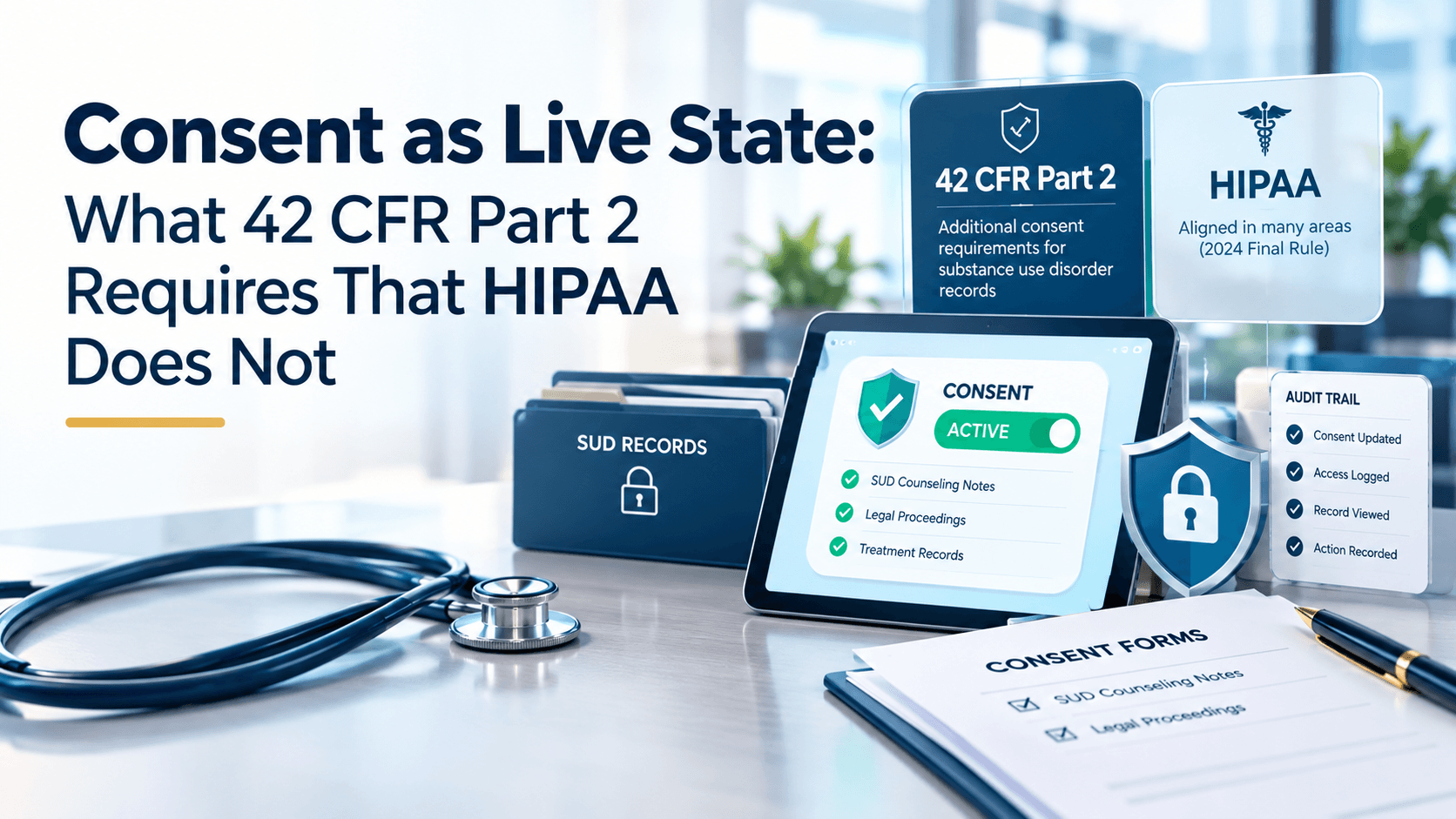
Most healthcare systems are built on an assumption that quietly stops being true the moment substance use disorder data enters them: that HIPAA is the ceiling.
For behavioral health it is the floor. Records created by federally assisted substance use disorder programmes fall under 42 CFR Part 2, a separate regime with a different consent standard, a different redisclosure obligation, and a different exposure profile. A system that treats all protected health information uniformly is not compliant for this data, no matter how well it implements HIPAA.
The timing matters. A final rule aligning Part 2 more closely with HIPAA was issued in February 2024, took effect that April, and carried a two year implementation window. The compliance date was 16 February 2026. That window has closed. Civil enforcement authority is now active, which is itself new, because the rule extended civil money penalties to Part 2 violations for the first time.
A note before the detail. What follows is engineering guidance, not legal advice. Questions involving court orders, law enforcement requests, and the interaction between Part 2 and state privacy law belong with counsel experienced in healthcare privacy.
Who this actually reaches
Wider than most teams assume, and this is the part that catches technology companies.
A Part 2 programme is a federally assisted programme that holds itself out as providing substance use disorder diagnosis, treatment, or referral. That covers addiction treatment centres, opioid treatment programmes, hospital based SUD units, and community mental health centres offering SUD services.
Then it extends. The regulation also reaches any entity that receives Part 2 records, including downstream HIPAA covered entities and business associates. So a general purpose platform that never intended to handle SUD data can inherit the obligation simply by receiving a record from a programme that does.
If you build or operate healthcare software that exchanges clinical data with behavioural health organisations, the question is not whether you are a Part 2 programme. It is whether Part 2 records can reach your system, and what happens when they do.
HIPAA and Part 2, side by side
Under HIPAAUnder Part 2Basis for disclosureTreatment, payment, and operations generally permitted without specific authorisationRequires patient consent, now available as a single consent covering future TPO usesConsent lifespanNot applicable to TPOValid until revoked in writing, so revocation is a state change your system must handleRedisclosure by recipientGoverned by HIPAA generallyCarries a redisclosure notice and continuing restrictions that travel with the recordUse in legal proceedingsSubject to HIPAA rulesCannot be used in criminal or civil proceedings without consent or a court orderBreach notificationHIPAA Breach Notification RuleSame rule now applies, including the four factor risk assessmentPenaltiesCivil money penaltiesNow aligned, with civil enforcement authority extended to Part 2
Read down the right hand column and notice what kind of requirements they are. Almost none of them are document requirements. They are behaviours a system has to exhibit at runtime, which is why policy compliance and technical compliance diverge so sharply here.
The single consent change, and what it does not remove
The headline change is that a patient can now give one consent covering all future uses and disclosures for treatment, payment, and healthcare operations, rather than a separate consent per recipient. That resolves a genuine barrier to care coordination, and historically it is why health information exchange vendors restricted SUD record exchange on their platforms at all.
What it does not do is turn consent into a filing task.
That consent remains valid until the patient revokes it in writing. It can carry patient requested restrictions. Both of those mean the system has to hold consent as live, queryable state rather than as a signed PDF in a document store. The practical test is simple: can your application answer, at the moment of a disclosure, whether this specific patient's consent currently permits this specific disclosure? If answering that requires a person to open a file, the answer arrives too late to govern anything.
That is a data model question before it is a feature question, which is why it belongs in backend development and in the design of the record layer itself through custom EMR and EHR development. Capture is the easier half, and sits naturally with intake forms software, where consent is collected alongside registration. Enforcement is the half that gets skipped.
The segmentation misunderstanding
Worth being precise here, because this is the point most commonly stated wrongly in both directions.
The final rule includes an express statement that segregating or segmenting Part 2 records is not required by Part 2 programmes, covered entities, or business associates that have received records on the basis of a single consent for all future TPO. That was a deliberate and welcome clarification, and it removed an assumed engineering burden from recipients.
It does not follow that a system never needs to know which records are Part 2 records. A programme disclosing data still has to apply the correct consent standard at the point of disclosure, which requires knowing what it holds. The relief applies to what recipients must do with records they have lawfully received, not to whether origin matters at all.
The practical consequence is that field level awareness of Part 2 origin remains useful even where segmentation is not mandated, because origin is what tells the system which rules apply on the way out. Teams that read the clarification as permission to stop tracking provenance entirely tend to discover the gap at the first disclosure request.
Given how easily this is misread, confirm your own interpretation with counsel rather than with an article, this one included.
The clinician's notes category
A quieter change with direct product implications.
The rule created a distinct category for a clinician's notes analysing a counselling session, where the clinician voluntarily keeps them separate from the rest of the treatment and medical record. These require specific consent and cannot be disclosed under a broad TPO consent. The protection is deliberately analogous to HIPAA's treatment of psychotherapy notes.
For anyone building behavioural health software, that is a second class of record inside the same chart, with its own consent rule and its own exclusion from the general permission. If your data model has one notes table and one permission check, it cannot express this. The design has to accommodate a record type that is visible to its author, excluded from routine disclosure, and releasable only against a separate and specific consent.
What a compliant system actually does
Four runtime behaviours, none of which appear on a typical feature list.
Knows the origin of the data. Field level awareness of what came from, or touched, a Part 2 programme, carried through integrations rather than lost at the first hop.
Holds consent as state. Current status, scope, restrictions, and revocation, queryable at the moment of decision rather than stored as a document.
Enforces at every egress. Care coordination, health information exchange, billing, analytics extracts, and reporting. Egress points multiply quietly, and an extract pipeline built for analytics is as much a disclosure path as a referral is.
Carries the notice forward. Redisclosure obligations travel with the record, so the system that sends it has to attach what the receiving system needs in order to honour them.
Those four are architectural. Retrofitting them into a platform designed on uniform HIPAA assumptions is substantially harder than building them in, which is the usual reason behavioural health organisations end up running separate systems that do not talk to each other, and then paying for integration work to reconnect them.
Where Woltrio fits
Woltrio builds clinical systems and the integration layers between them, which is where the Part 2 problem actually lives. The regime is rarely difficult to satisfy inside a single application. It becomes difficult the moment data moves, and movement is the entire point of modern healthcare architecture.
Typical engagements here are a consent service that other systems can query, provenance tracking through integration layers so Part 2 origin survives the journey, and egress controls on the pipelines nobody thinks of as disclosure paths. That work sits across services, and for organisations running mixed estates it usually starts with mapping where SUD data can currently travel unchecked.
One honest caveat to close on. Compliance posture on this should be set with counsel, and the engineering should implement a position that lawyers have signed off rather than one an engineering team inferred from a rule summary. The useful division of labour is that counsel decides what must be true, and the build makes it true at runtime.
Start with a scoped assessment from Woltrio.