

























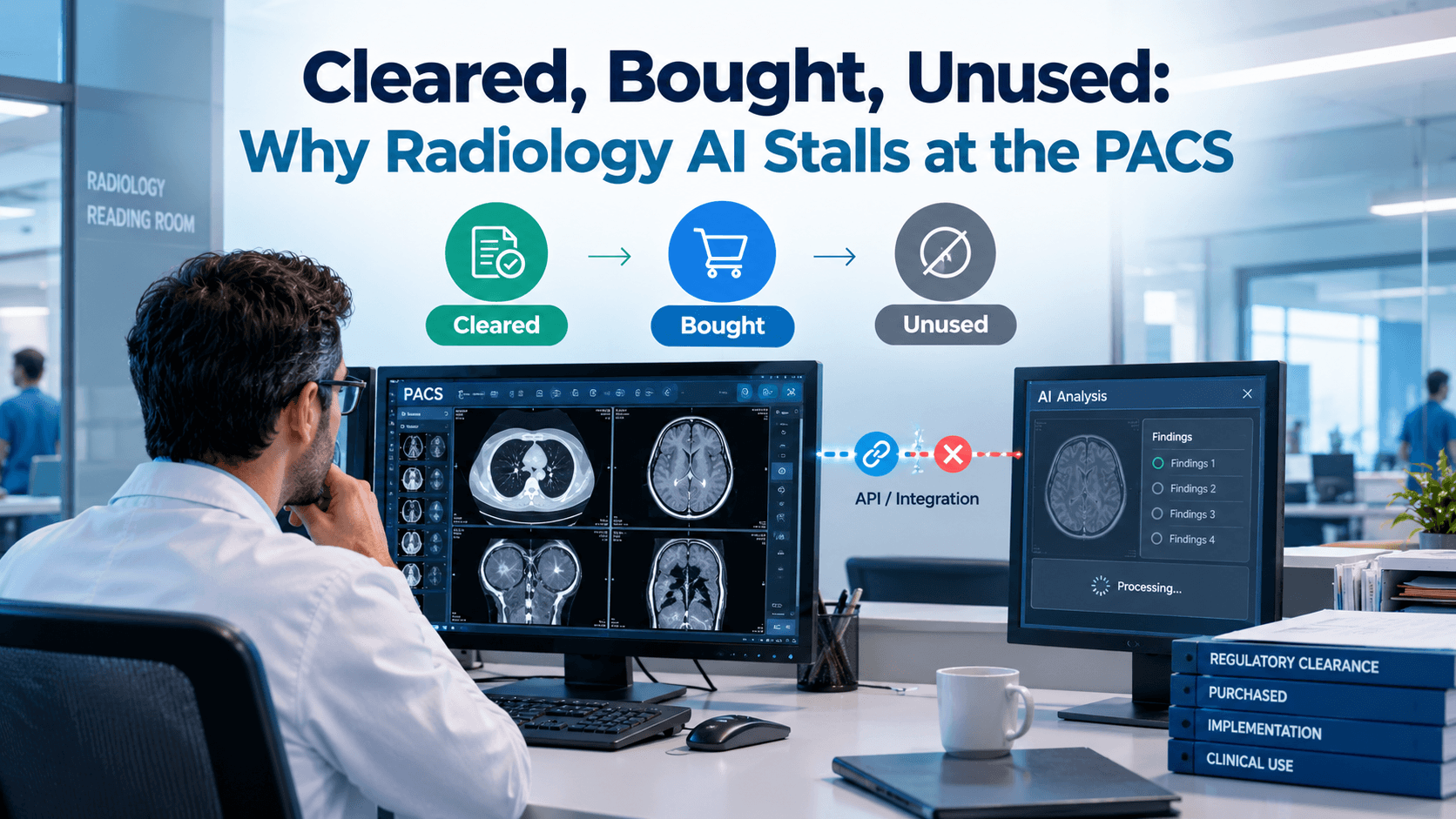
Three numbers describe the state of radiology AI, and they do not fit together comfortably.
Radiology accounts for roughly three quarters of every AI-enabled medical device the FDA has authorised. In a cross-sectional analysis of 1,430 authorisations from 1995 through 2025, the radiology panel accounted for 1,094 of them, and radiology, cardiovascular, and neurology together made up more than 90 percent. Annual authorisations rose from a mean of under two a year through 2014 to several hundred a year by 2025.
Only about 30 percent of radiologists report using AI in clinical practice.
And in a systematic analysis of 1,357 cleared devices, 34 were linked to registered prospective trials, 12 had peer-reviewed publications, and three evaluated patient-centered outcomes such as mortality, morbidity, or readmission. Three, out of more than thirteen hundred.
So the category has enormous regulatory throughput, modest clinical uptake, and almost no outcome evidence. Understanding why requires two separate explanations, because clearance fails to predict capability for one reason and fails to predict deployment for a completely different one.
A note on the counts. Different analyses report different totals, from roughly 1,250 to over 1,500, depending on cut-off date and inclusion criteria, and the FDA itself cautions that its list is not comprehensive. The proportions hold steady across every dataset. Treat the shares as solid and any precise total as approximate.
Why clearance does not mean capability
Almost all of these devices clear through the 510(k) pathway, which requires demonstrating substantial equivalence to an existing marketed product rather than prospective validation of clinical effectiveness.
That is not a scandal. It is the pathway working as designed, for a class of product it was not designed around. But it means a clearance tells you a device is comparable to something already sold. It does not tell you the device improves decisions, and the evidence base confirms that gap: most supporting studies are observational, with small homogeneous cohorts and limited subgroup analysis.
The practical consequence for a buyer is that regulatory approval cannot be used as a proxy for trustworthiness. It is a floor, and a lower one than the marketing around it implies.
Why clearance does not mean deployment
Different problem entirely, and this one is plumbing.
Every radiologist who is positive about AI in principle raises the same friction: getting the tool to work inside their existing worklist. Not accuracy, not trust, not cost. The integration.
To understand why that is hard, you need the stack. Here it is, decoded.
DICOM. The standard for medical images and their metadata, dating to the early 1990s. It covers both the file format and the network protocol, and it carries far more than pixels: patient identifiers, study and series structure, acquisition parameters. It is old, heavily extended, and inconsistently implemented, which makes it the imaging equivalent of the HL7 v2 local-variation problem.
PACS. The picture archiving and communication system. Stores studies and serves them to the reading workstation. This is where radiologists actually work, which is why it is the only place an AI result matters.
VNA. The vendor neutral archive. A storage layer that holds images independent of any single PACS, usually introduced so an organisation can change PACS without migrating decades of studies.
RIS. The radiology information system. Orders, scheduling, status, and reporting. Talks to the wider record system, typically over HL7, and is where the order that produced the study originated.
The worklist. The queue that determines what a radiologist reads next, and in what order. Almost every meaningful AI intervention in radiology is ultimately an attempt to change this queue or annotate the study sitting in it.
IHE profiles. Integration profiles that specify how these components should work together for a given use case, including radiology profiles covering AI output. They are the closest thing the field has to a shared integration contract.
Now the failure mode is visible. An AI tool has to receive the study, run inference, and return a result into the radiologist's existing reading environment quickly enough to matter, without asking them to open anything else. Miss any part of that and the tool is technically deployed and practically unused. A result that arrives in a separate portal is a result nobody reads during a shift.
That is an integration problem in backend development and cloud engineering terms, not a machine learning problem.
The problem that arrives after the third tool
Organisations that solve integration for one algorithm discover a second problem, now widely described as AI sprawl.
Each tool arrives with its own integration pattern, its own notification behaviour, and often its own worklist. One posts a flag into the PACS. Another writes a risk score into a separate queue. A third emails somebody. Departments end up with several AI products that do not share a deployment path, a monitoring approach, or a common place for their output to land.
The organisations handling this well stop buying point integrations and build an orchestration layer once: a single route for studies to reach any model, a single route for results to return to the worklist, and a single place where performance is monitored. That reframes the purchasing question from which algorithm to which platform can host algorithms, and it is a substantially better question.
It is also the point where this connects to governance. A deployed model needs input monitoring, override tracking, and scheduled revalidation regardless of specialty, which is the subject of the clinical AI monitoring runbook and applies here with particular force given how thin the outcome evidence is.
What to establish before deploying
Five things, and the first two are rarely asked.
What evidence exists beyond the clearance. Ask for prospective data on a population resembling yours. Given the base rates above, a vendor with genuine outcome evidence is unusual and should be treated as a meaningful differentiator rather than a baseline expectation.
How the result reaches the radiologist. Specifically: does it land in the existing worklist and reading environment, or somewhere else. Anything else is a pilot that will quietly lapse.
What the round trip time is under real load. Inference speed is not the constraint. Transfer of large studies, queueing, and return path are.
Whether it fits an orchestration layer or demands its own. The third tool is when this becomes expensive, so ask at the first one.
Who monitors it after go-live, and against what. Clearance is a point-in-time event. Performance is not.
Where Woltrio fits
Woltrio builds the routing, integration, and monitoring layers that sit between imaging systems and the models running against them, rather than building the models.
In practice that means DICOM routing and de-identification pipelines, return paths that deliver results into the environment radiologists already work in, and the orchestration layer that stops the fourth AI tool costing as much to deploy as the first three combined. Where an imaging AI company is still establishing whether its product can live inside a customer's estate, a scoped MVP integrated against one real PACS answers that faster than any amount of accuracy benchmarking. Where the monitoring question dominates, that work extends into AI development and the healthcare data analytics platform layer, and where results need to reach the wider record it touches custom EMR and EHR development.
The summary is uncomfortable and useful. The field has produced over a thousand cleared radiology devices and almost no evidence that patients are better off, and the single most cited obstacle to using any of them is workflow integration. Both of those are problems the buyer inherits, and neither is solved by picking a better algorithm.
Start with a scoped assessment from Woltrio.