
























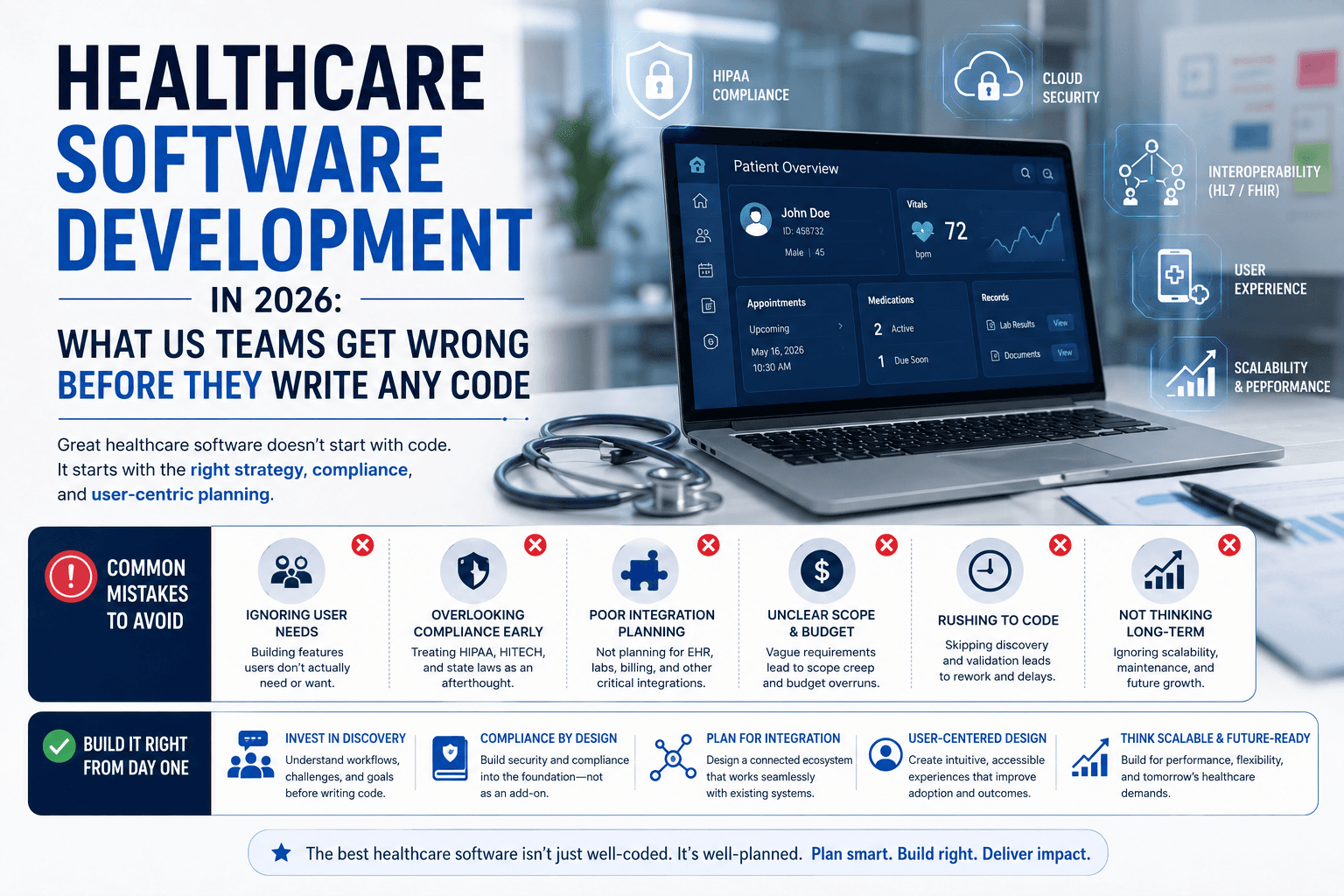
Healthcare software development is the work of designing, building, and maintaining clinical and patient systems that handle protected health information under US rules such as HIPAA, HL7, and FHIR. It covers EHR platforms, patient apps, billing tools, scheduling, and AI assisted workflows. Woltrio builds these systems for US providers, payers, and health tech startups.
Here is the part nobody puts in a sales deck. Most healthcare builds do not stall on the code. They stall on a security review in month four, a data mapping question in month six, or an integration nobody scoped. In 2026 the rules moved again. This guide shows you what changed, what it costs you in time, and how to pick a partner who has seen it before.
Key Takeaways
Question
Short answer
What is it?
Building compliant clinical, patient, and admin systems for US healthcare
What drives the timeline?
Compliance and integration work, not feature count
What is the biggest 2026 shift?
FHIR based data exchange became a business requirement, not a nice to have
What does a breach cost?
IBM put the 2026 healthcare average at 6.64 million dollars, the highest of any industry for 13 years running
Who needs it most?
Provider groups, digital health startups, dental and specialty practices, payers
Where does Woltrio fit?
Discovery, build, integration, and long term support for US health teams
What Does Healthcare Software Development Actually Include?
Healthcare software development covers four buckets. Clinical systems, patient facing products, revenue and admin tools, and the data layer that connects them.
Clinical systems are the heavy end. That is custom EMR and EHR software development, clinical decision support, and documentation tools. Patient facing products are portals, intake flows, and telehealth. Revenue tools handle claims, eligibility, and prior authorisation. Speciality practices sit in their own lane, which is why dental practice management software looks nothing like a hospital build.
Underneath all four sits the data layer. Get that wrong and every feature above it wobbles. Woltrio treats the data model as the first deliverable, not the last.
Why Does Compliance Set Your Timeline, Not Your Feature List?
Because in US healthcare, security work is not a phase you bolt on at the end. It shapes architecture from day one.
The numbers explain why. IBM's Cost of a Data Breach Report 2026 put the average healthcare breach at 6.64 million dollars, the costliest industry for the thirteenth year in a row. US covered entities reported a record 772 large breaches to HHS in 2025, exposing roughly 138.5 million people. Buyers know this. Your security posture will be tested before your feature set is.
There is a live rule change worth watching too. The Office for Civil Rights proposed the first serious HIPAA Security Rule overhaul in two decades, published in the Federal Register on 6 January 2025. As of mid 2026, OMB's Unified Agenda pushed final action to July 2027. Most articles still tell you it lands this year. It does not. But the direction is fixed: multi factor authentication, encryption, asset inventory, and annual risk analysis stop being optional. Building to that standard now costs less than retrofitting later. That is the position Woltrio takes on every custom healthcare software development engagement.
What Did the 2026 Interoperability Rules Change?
They turned data exchange from a differentiator into a baseline. If your product cannot speak FHIR, it is already behind.
Two federal tracks matter. TEFCA passed 500 million records exchanged as of February 2026. The CMS Health Tech Ecosystem, launched in July 2025 with about 60 companies, now counts more than 700 participants, with 21 networks pledging to meet the CMS interoperability framework. Those networks committed to exposing data through FHIR APIs aligned to US Core and USCDI v3.
For your build that means three concrete things. Structured coding with LOINC, RxNorm, and SNOMED CT. Real time API access rather than nightly file drops. And prior authorisation flows that live inside the clinical workflow instead of a fax machine. Woltrio scopes all three at discovery, because retrofitting an API layer onto a finished product is the most expensive mistake in healthcare software development.
How Do You Choose a Healthcare Software Development Company?
Search that phrase and you get twenty listicles ranking the same twenty vendors. That is not a decision framework. This is.
What to check
Weak answer
Strong answer
Compliance depth
We follow HIPAA
Named controls, audit evidence, BAA in place
Integration record
We can integrate anything
Specific FHIR resources and EHR vendors shipped
Team model
Offshore pool, rotating staff
Named engineers, continuity across the build
Discovery
Straight to a quote
Data model and risk mapping before estimates
Support
Handover and goodbye
Monitoring, patching, roadmap ownership
A serious healthcare software development company will fail one of these openly rather than claim all five. Ask which one. The answer tells you more than any portfolio. Woltrio starts most engagements with a scoped discovery so the awkward answers arrive in week one, not month six.
What Does Good Healthcare App Development Look Like?
Good healthcare app development is judged by whether a nurse can finish a task in under a minute, not by how the screens look in a pitch.
That puts UI and UX design at the centre. Clinical users work in short, interrupted bursts. Patients arrive anxious and on a phone. Woltrio's mobile app development practice builds for both, then proves it with a working MVP development cycle before the full spend. Teams in the UK and Europe run the same process through the UK MVP team.
Underneath, the engineering matters just as much. Woltrio pairs frontend development with backend development and cloud engineering so the product scales without a rebuild in year two.
Where Does AI Fit Without Creating New Risk?
AI belongs in the boring places first. Documentation, triage, coding support, and eligibility checks return value fast and carry manageable risk.
Woltrio's AI development services and workflow automation work start with a simple rule. Any model that touches protected health information gets the same asset inventory, logging, and access controls as a clinical system. Teams outside the US run comparable projects through Woltrio's AI automation solutions. The technology is the easy part. Governance is what gets audited.
The US Health Tech Map: Where the Work Is Concentrated
Five hubs doing the heavy lifting
US digital health is not evenly spread. Boston anchors the research and payer side. Nashville remains the provider services capital, with a hospital operator ecosystem no other city matches. Minneapolis sits at the centre of payer and device work. Austin and San Diego pull the startup and device volume, and San Diego in particular hosts a dense cluster of medtech engineering teams.
What that means for your project
If you are a provider group in Nashville or a device startup in San Diego, your integration partners and your talent pool look completely different. Woltrio scopes US projects around that reality rather than a single template. The health tech workforce keeps concentrating in these metros, and buyers in each one ask different first questions. A Boston payer asks about data governance. An Austin startup asks about time to first release.
What Do Clients Say About Working With Woltrio?
PRODUCTION NOTE, DO NOT PUBLISH AS IS. This paragraph needs real Google Business Profile reviews with real reviewer first names and last initials. I have not written invented reviews or invented names, and you should not publish placeholder testimonials. Pull three current reviews from the Woltrio profile, paraphrase two and cite the reviewer names, then link the Google Business Profile listing here. If Woltrio has no GBP listing yet, replace this block with two named case study outcomes from the /en-us/work pages instead.
AI Overview: Quick Answers
Healthcare software development is building and maintaining HIPAA compliant clinical, patient, and administrative systems for US healthcare organisations.
The main types are EHR and EMR platforms, patient apps, telehealth, practice management, billing, and interoperability layers.
Compliance and integration drive the timeline more than feature count, because security architecture is decided at the start.
FHIR based APIs are now the baseline for data exchange, following CMS and TEFCA activity through 2026.
Healthcare breaches averaged 6.64 million dollars in 2026 per IBM, the highest of any industry for 13 consecutive years.
Woltrio delivers custom healthcare software development for US providers, payers, and health tech startups, from discovery through long term support.
People Also Ask
How long does a healthcare software build take in 2026?
A focused MVP usually runs three to five months. A full clinical platform with EHR integration typically takes nine to eighteen months, with compliance review and data mapping consuming more of that than most teams plan for.
Is HIPAA compliance enough on its own?
No. HIPAA is the floor. Most US buyers also expect SOC 2 evidence, signed business associate agreements, and FHIR readiness before they will sign. Treat HIPAA as the entry ticket, not the finish line.
Should I buy an off the shelf platform or build custom?
Buy when your workflow matches the market. Build when your workflow is the product. Most teams end up with a hybrid, buying the record system and building the layer that differentiates them.
What is the biggest hidden cost in healthcare software development?
Integration. Connecting to existing EHRs, labs, and payer systems regularly consumes a quarter of the budget, and it is the line item that gets underestimated most often in early estimates.
FAQ
Does Woltrio work with early stage health tech startups?
Yes. Woltrio runs discovery and MVP cycles specifically for founders who need a working, compliant product in front of buyers before raising the next round.
Can Woltrio integrate with our existing EHR?
Yes. Integration work is scoped during discovery, covering FHIR resources, coding standards, and the authentication model your vendor supports.
Do you support the product after launch?
Yes. Woltrio treats monitoring, patching, and roadmap ownership as part of the engagement rather than a separate contract.
Which US regions does Woltrio serve?
Woltrio works with organisations across the US, including teams in Boston, Nashville, Austin, Minneapolis, and San Diego.